Introduction
For centuries, meditation was the purview of monasteries and spiritual seekers, described in the language of philosophy, mysticism, and subjective experience. Its benefits—calm, clarity, insight—were considered intangible gifts of a disciplined mind. The late 20th and early 21st centuries, however, have witnessed a profound paradigm shift. With the advent of advanced neuroimaging technologies like fMRI (functional Magnetic Resonance Imaging) and EEG (Electroencephalography), we can now peer inside the living, meditating brain. This scientific inquiry has revealed a startling and revolutionary truth: the deliberate practice of mental stillness does not merely change one’s temporary state of mind; it physically and permanently alters the very structure and function of the brain. This process, known as neuroplasticity—the brain’s lifelong capacity to reorganize itself by forming new neural connections—is the biological engine of meditation’s transformative power. This essay, “The Neuroscience of Stillness,” will explore the concrete, evidence-based ways in which meditation acts as a powerful sculptor of the brain’s architecture. We will examine how it strengthens the prefrontal cortex, the seat of executive control; shrinks and calms the amygdala, the hub of fear and reactivity; thickens and enhances key regions associated with attention, awareness, and empathy; and regulates the brain’s fundamental networks, leading to a sustained shift from a state of stress and distraction to one of presence and resilience. This is not metaphor, but measurable morphology; not just feeling better, but forging a better brain.
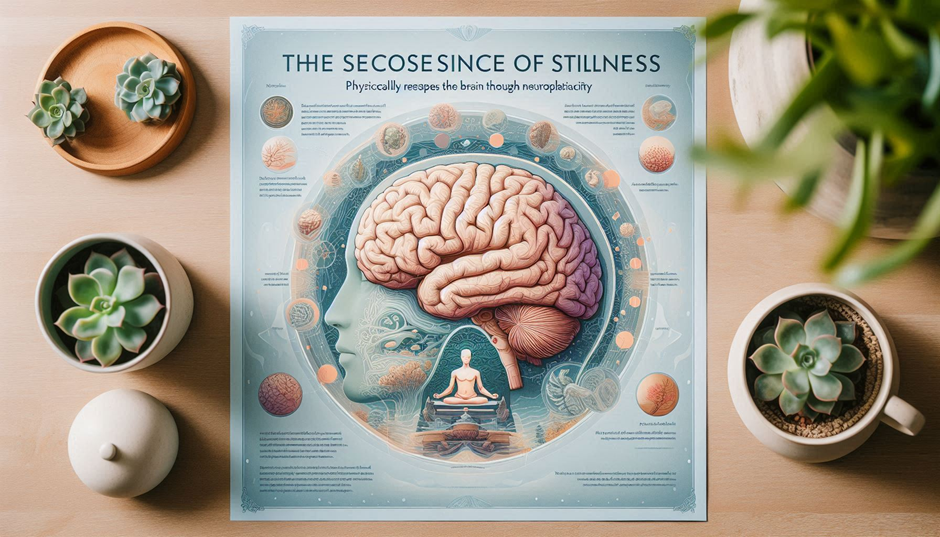
1. The Foundation of Change: Harnessing Neuroplasticity Through Mental Training
To understand how meditation reshapes the brain, one must first abandon the outdated notion of the brain as a static, hardwired organ. Neuroplasticity is the foundational principle that makes this transformation possible. It refers to the brain’s dynamic, lifelong ability to reorganize its structure, functions, and connections in response to experience, learning, and directed mental activity. “Neurons that fire together, wire together,” the famous axiom coined by psychologist Donald Hebb, encapsulates this process. Repeated patterns of thought and behavior strengthen specific neural pathways, while neglected pathways weaken. This is how we learn a language, master a musical instrument, or develop a habit. Crucially, neuroplasticity is a double-edged sword; chronic stress, rumination, and anxiety also reinforce their own maladaptive circuits.
Meditation represents a highly systematic and deliberate form of mental training that leverages neuroplasticity for psychological benefit. It is, in essence, a workout for specific cognitive and emotional muscles. When an individual consistently practices focusing attention on the breath (as in Focused Attention meditation), or cultivates an open, non-judgmental awareness of passing thoughts and sensations (as in Open Monitoring or mindfulness meditation), they are engaging in repetitive cognitive exercises. This repeated firing of circuits involved in attention regulation, metacognition (awareness of one’s own thinking), and emotional distancing promotes the strengthening of those circuits. The brain, responding to the consistent demand, allocates more resources: it increases the density of grey matter (the tissue containing neuronal cell bodies) in relevant regions, enhances the white matter (the insulated wiring that connects regions) for more efficient communication, and fortifies synaptic connections.
Early skepticism asked whether the seemingly passive act of sitting quietly could induce such physical change. Landmark studies, most notably those led by Sara Lazar and her team at Harvard, provided definitive proof. Using MRI scans, they demonstrated that long-term meditators had significantly greater cortical thickness in brain regions associated with attention and sensory processing compared to non-meditators. Even more compelling, follow-up research showed that participants in an 8-week Mindfulness-Based Stress Reduction (MBSR) program exhibited measurable increases in grey matter density in the hippocampus (crucial for learning and memory) and decreases in the amygdala. These changes were correlated with self-reported reductions in stress. This evidence firmly establishes that the mental exercise of meditation induces structural neuroplasticity. The brain is not a passive recipient of experience but an active, malleable organ that physically evolves to reflect where we consistently place our attention and intention. Meditation is the disciplined practice of directing that attention inward, and the brain, obeying the laws of plasticity, adapts accordingly.
2. Fortifying the Executive: Meditation and the Strengthening of the Prefrontal Cortex
If the brain were a corporation, the prefrontal cortex (PFC), located just behind the forehead, would be the Chief Executive Officer. It is the seat of executive functions: the higher-order cognitive processes that allow for goal-directed behavior, thoughtful decision-making, emotional regulation, focused attention, and impulse control. In the chaotic stream of modern life, with its incessant demands and distractions, the PFC can become overwhelmed, leading to reactive, emotionally-driven decisions and a scattered mind. Meditation serves as a rigorous executive training program, directly strengthening the PFC and enhancing its ability to govern the brain’s activities.
Neuroimaging studies consistently show that meditation increases activity, grey matter density, and functional connectivity within the PFC, particularly in the dorsolateral prefrontal cortex (dlPFC), which is central to cognitive control and attention. During focused attention meditation, when the practitioner notices the mind has wandered and gently returns it to the breath, they are performing a precise executive function. This act of monitoring awareness (realizing you’re distracted) and implementing control (redirecting attention) is a direct workout for the dlPFC. Each repetition is like a rep for this cognitive muscle, reinforcing the neural pathways that underlie volitional attention. Over time, this leads to a “toned” PFC that is more adept at maintaining focus in everyday life, resisting distracting stimuli, and staying on task.
Furthermore, meditation enhances the PFC’s crucial role as a modulator of the brain’s emotional centers. One of the PFC’s key jobs is to provide top-down regulation to the limbic system, especially the amygdala—the brain’s alarm bell for threat and fear. A strong, well-connected PFC can assess an emotional stimulus and dampen an overblown amygdala response, allowing for a measured reaction instead of a blind panic. Meditation strengthens the neural highway between the PFC and the amygdala. Practitioners learn to observe emotional surges—anger, anxiety, craving—with a degree of detachment, creating a space between feeling and action. This “pause” is neurologically facilitated by a more robust PFC applying inhibitory control over the limbic system. Consequently, meditators show not only reduced amygdala activity in response to stressors but also a faster return to baseline after being provoked. In practical terms, this means less time spent hijacked by emotional storms, quicker recovery from upsets, and a greater capacity for rational response. By systematically exercising the prefrontal cortex, meditation builds a more capable, calm, and authoritative executive in the brain, enabling improved focus, better emotional regulation, and wiser decision-making.
3. Quieting the Alarm: Meditation’s Calming Effect on the Amygdala
The amygdala, a small, almond-shaped cluster of nuclei deep within the brain’s temporal lobe, is the cornerstone of the survival-oriented limbic system. It functions as a hypersensitive alarm system, constantly scanning the environment for threats. When it perceives danger—whether a physical predator, a critical email, or a worrisome thought—it triggers the body’s fight-or-flight response: cortisol and adrenaline surge, heart rate accelerates, and attention narrows to the perceived threat. While essential for genuine emergencies, the modern amygdala is often chronically overactive, responding to psychological and social stressors with the same physiological intensity as a physical attack. This leads to a baseline state of anxiety, irritability, and hyper-vigilance. One of the most robust and significant findings in contemplative neuroscience is that meditation directly down-regulates this amygdala reactivity.
Structural MRI studies reveal that experienced meditators, and even novices after short-term training programs like MBSR, tend to have a smaller amygdala volume. This reduction in size is not a degeneration but a reflection of decreased dendritic branching and synaptic density—a “pruning” of the overgrown neural connections that sustain a state of chronic stress and reactivity. A smaller, less metabolically active amygdala is a calmer amygdala. Functional MRI studies provide the dynamic picture: when exposed to emotionally charged images or placed under stress, meditators show significantly less activation in the amygdala compared to non-meditators. The alarm still rings, but it’s quieter and shorter-lived.
The mechanism behind this calming is twofold. First, as described, meditation strengthens the “braking” power of the prefrontal cortex. Second, and perhaps more profoundly, mindfulness meditation changes the individual’s relationship to their own emotional experience. Instead of being fully identified with and swept away by an anxious thought or a pang of fear—a state where the amygdala is fully in charge—the practitioner learns to observe these sensations with curiosity and non-attachment. This metacognitive stance, often described as “watching the thought without becoming the thought,” creates a neurological buffer. The sensory input (the worry) is still processed, but the secondary, reactive narrative (“This is terrible, what if it happens?”) that typically amplifies the amygdala’s response is diminished. The practitioner recognizes the feeling as a transient mental event, not an immutable truth. This de-identification process, supported by increased activity in the anterior cingulate cortex (a region involved in error detection and emotional regulation), prevents the amygdala from launching into a full-scale alert. The result is a fundamental shift from being reactive to being responsive. The individual gains freedom from the tyranny of the amygdala’s false alarms, experiencing less chronic anxiety, greater emotional stability, and a more enduring sense of safety and peace.
4. Integrating the Self: Meditation’s Regulation of the Brain’s Default Mode and Salience Networks
Beyond strengthening specific regions like the PFC and calming the amygdala, meditation induces a higher-order reorganization of the brain’s large-scale networks. Two networks are particularly pivotal in this transformation: the Default Mode Network (DMN) and the Salience Network (SN). The DMN is a interconnected set of brain regions, including the medial prefrontal cortex and the posterior cingulate cortex, that becomes active when the mind is not focused on the external world. It is the neurological substrate of the “narrative self”—the generator of self-referential thought, mind-wandering, reminiscence about the past, and planning for the future. While essential for creativity and autobiographical sense, an overactive, poorly regulated DMN is the engine of rumination, worry, and the pervasive sense of “not being present.” It is the voice that constantly comments, judges, and spins stories about “me.”
Meditation directly targets the DMN’s hyperactivity. During meditation, as one focuses on present-moment awareness (the breath, bodily sensations, sounds), activity in the DMN decreases. More importantly, long-term practice leads to lasting changes in the DMN’s functional architecture. Experienced meditators show reduced baseline activity and connectivity within the DMN, particularly in the hubs associated with self-referential processing. This correlates with the subjective experience of reduced ego-centric thinking and less attachment to the “story of me.” Furthermore, they exhibit stronger anti-correlation between the DMN and task-positive networks (like the attention network). This means when they need to focus, the mind-wandering DMN quiets down more effectively, leading to less distractibility. In essence, meditation weakens the grip of the wandering, storytelling mind, freeing up cognitive resources for direct experience.
Simultaneously, meditation enhances the function of the Salience Network. The SN, anchored in the anterior insula and anterior cingulate cortex, acts as the brain’s switchboard operator. It monitors internal and external stimuli, detects what is most salient or important in any given moment, and directs attention and resources accordingly. A well-tuned SN is crucial for emotional intelligence and cognitive flexibility. Meditation, especially mindfulness practices that involve noting bodily sensations and emotional feelings, intensely trains the SN. The practitioner is repeatedly engaging the insula to interoceptively track subtle bodily states and the anterior cingulate to notice when attention has drifted (an “error” signal). This practice thickens the cortical regions of the SN and improves its efficiency. A robust SN allows an individual to more accurately and quickly detect a rising emotion, a distracting thought, or a relevant environmental cue. It enables a smoother, more adaptive switching between the introspective DMN and the outwardly-focused attention networks. The combined effect—a quieter DMN and a sharper SN—is a brain that is less lost in self-referential narrative and more adept at being flexibly and fully engaged with the present moment. This network-level rewiring underpins the profound sense of presence, equanimity, and integrated awareness that is the hallmark of an advanced meditation practice.
Conclusion
The neuroscience of stillness moves meditation from the realm of subjective well-being into the domain of objective, biological change. It reveals that the ancient practice is a potent form of self-directed neuroplasticity, a means by which we can consciously reshape our own brains to foster resilience, peace, and clarity. The evidence is clear and compelling: meditation strengthens the prefrontal cortex, enhancing executive control and emotional regulation; it shrinks and calms the overreactive amygdala, reducing baseline anxiety and fear; it increases grey matter in regions vital for learning, memory, and empathy; and it reconfigures the brain’s core networks, quieting the restless narrative of the Default Mode while sharpening the present-moment awareness governed by the Salience Network. This is not a passive or mystical process but an active, trainable skill with concrete anatomical and functional correlates. The implications are profound for mental health, education, and personal development. Meditation offers a scientifically-validated toolkit not just for coping with a stressful world, but for fundamentally upgrading the instrument through which we experience that world—our own brain. It proves that by changing the mind, we quite literally change the brain, and in doing so, open the door to a more centered, focused, and emotionally balanced human experience.
SOURCES
Brewer, J. A., et al. (2011). Meditation experience is associated with differences in default mode network activity and connectivity. Proceedings of the National Academy of Sciences.
Davidson, R. J., & McEwen, B. S. (2012). Social influences on neuroplasticity: Stress and interventions to promote well-being. Nature Neuroscience.
Fox, K. C., et al. (2014). Is meditation associated with altered brain structure? A systematic review and meta-analysis of morphometric neuroimaging in meditation practitioners. Neuroscience & Biobehavioral Reviews.
Goleman, D., & Davidson, R. J. (2017). Altered traits: Science reveals how meditation changes your mind, brain, and body. Avery.
Hölzel, B. K., et al. (2011). Mindfulness practice leads to increases in regional brain gray matter density. Psychiatry Research: Neuroimaging.
Lazar, S. W., et al. (2005). Meditation experience is associated with increased cortical thickness. Neuroreport.
Tang, Y.-Y., Hölzel, B. K., & Posner, M. I. (2015). The neuroscience of mindfulness meditation. Nature Reviews Neuroscience.
Taren, A. A., et al. (2013). Mindfulness meditation training alters stress-related amygdala resting state functional connectivity. Social Cognitive and Affective Neuroscience.
Vago, D. R., & Silbersweig, D. A. (2012). Self-awareness, self-regulation, and self-transcendence (S-ART): A framework for understanding the neurobiological mechanisms of mindfulness. Frontiers in Human Neuroscience.
HISTORY
Current Version
Dec 16, 2025
Written By
BARIRA MEHMOOD



0 Comments