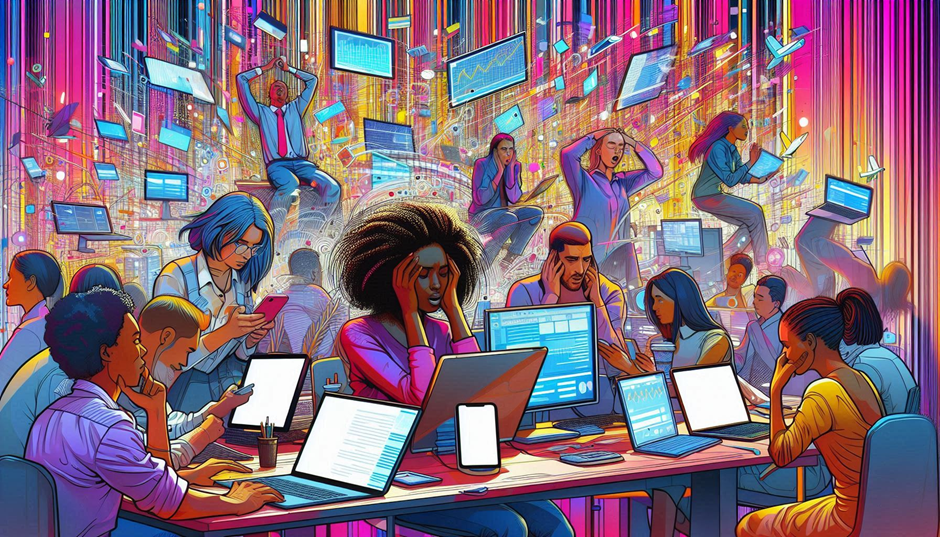
The 21st century has been defined by a technological revolution that has fundamentally reshaped the fabric of human existence. From the smartphone in our pocket to the cloud servers processing our data, digital tools have woven themselves into the very core of our professional, personal, and social lives. This integration promises unparalleled efficiency, global connectivity, and access to information, ostensibly freeing us from the physical and temporal constraints of the past. Yet, beneath the glossy surface of this hyper-connected reality, a pervasive and insidious psychological strain has emerged, one directly generated by our very tools of liberation. This phenomenon is known as tech-induced stress, or techno-stress. Techno-stress refers to the negative psychological, physiological, and behavioral states that result from an inability to cope healthily with the introduction and use of new information and communication technologies (ICTs). It is not merely the stress of using a faulty device but a chronic condition stemming from the constant demands, invasions, and paradoxes that modern technology imposes. The digital environment, with its core characteristics of perpetual connectivity, information overload, accelerated pace, and blurred boundaries, has created a unique ecosystem of stressors that our evolutionary psychology is ill-equipped to handle. This essay will argue that techno-stress is a defining malady of our age, a systemic issue arising from the architecture of our digital tools and the cultures they foster. By examining its primary manifestations—the tyranny of constant connectivity, the cognitive siege of information overload, the pressure of relentless technological change, and the erosion of personal boundaries—we can delineate the multifaceted nature of this modern stressor. Ultimately, understanding techno-stress is not a call to Luddism but a critical step towards reclaiming human agency, designing healthier technologies, and establishing sustainable digital hygiene practices in an era where disconnection has become a radical act.
1. The Tyranny of Constant Connectivity and the “Always-On” Culture
The most palpable and pervasive source of techno-stress stems from the paradigm of constant connectivity, which has fostered an insidious “always-on” culture. The invention of the smartphone, coupled with ubiquitous high-speed internet and a suite of collaborative platforms like Slack, Microsoft Teams, and email, has effectively erased the traditional boundaries between work and home, professional duty and personal time. Where once leaving the office signified a tangible end to the workday, the digital leash now ensures that the office is perpetually in our pocket. This creates a state of chronic anticipatory stress, where the individual is psychologically primed for interruption, demand, or notification at any hour. The ping of a new email, the vibration signaling a message in a work chat, or the mere sight of an unread notification badge triggers micro-doses of cortisol, the body’s primary stress hormone. Over time, this constant, low-grade activation exhausts the adrenal system and prevents the deep psychological recovery necessary to mitigate stress. The brain never receives the unambiguous signal that it is safe to fully disengage, rest, and restore.
This always-on expectation is not merely a user habit but is often explicitly or implicitly enforced by organizational cultures. The ability to respond quickly at all hours is misconstrued as dedication, productivity, and reliability, creating a competitive environment where employees feel compelled to demonstrate their commitment through digital responsiveness. This is exacerbated by remote and hybrid work models, which, while offering flexibility, have often dissolved the physical and temporal container of work entirely. When the home becomes the office, the cognitive association between space and function breaks down, making it exceedingly difficult to mentally “clock out.” The stress generated is twofold: it involves the actual labor of responding after hours and, more drainingly, the continuous cognitive and emotional labor of monitoring—the state of vigilance, waiting for the next demand. This leads to a phenomenon researchers term “telepressure,” an obsessive concern with responding immediately to message-based communications, which is strongly linked to burnout, diminished well-being, and sleep disturbances. Furthermore, constant connectivity corrodes the quality of our attention in the personal sphere. The presence of the device during family dinners, social gatherings, or moments of solitude creates a state of “continuous partial attention,” where we are never fully present in any one context. This fracturing of attention not only diminishes the restorative quality of leisure and social connection but also induces guilt and anxiety—stress about neglecting work when at home, and stress about neglecting loved ones when mentally at work. Thus, the very tool designed to connect us and set us free becomes a source of omnipresent obligation, fragmenting our focus and preventing the genuine disengagement required for mental health and sustained creativity.
2. Information Overload and Cognitive Overwhelm
If constant connectivity attacks our capacity for undisturbed time, information overload assaults our cognitive processing capabilities. The digital age has unleashed an unprecedented deluge of data, news, communication, and entertainment into our daily lives. We are exposed to more information in a single day than a person in the 15th century might have encountered in a lifetime. While access to information is a form of power, the volume, velocity, and variety of the digital information stream have far exceeded the human brain’s evolved capacity for filtration and synthesis. This results in a state of chronic cognitive overwhelm, a key component of techno-stress. The brain’s prefrontal cortex, responsible for executive functions like decision-making, prioritization, and focused attention, becomes overloaded. Every email subject line, news alert, social media update, and app notification represents a micro-decision: to engage or ignore, to read now or later, to save or delete. This constant barrage of “cognitive low-level tasks” depletes our mental bandwidth, leading to decision fatigue, reduced capacity for deep thought, and a pervasive sense of being mentally swamped.
The architecture of our digital platforms is deliberately engineered to maximize engagement, often at the expense of our cognitive peace. Infinite scroll features, autoplay videos, personalized news feeds that constantly refresh, and persuasive design elements like red notification dots all exploit psychological vulnerabilities to keep us consuming information. This transforms the user from an active seeker of information into a passive, overwhelmed recipient in a state of “alert fatigue.” The stress emerges from the gap between the desire to stay informed, competent, and socially aware and the sheer impossibility of processing the firehose of available data. Professionally, this manifests as email inboxes with thousands of unread messages, the pressure to stay abreast of every industry report and update on multiple channels, and the difficulty of extracting signal from noise. The anxiety of missing something critical—the “fear of missing out” applied to professional relevance—is a significant stressor. In our personal lives, the 24/7 news cycle, with its emphasis on conflict and crisis, exposes us to a distorted, often traumatic, view of world events, leading to “headline stress disorder” or “doomscrolling,” where compulsive consumption of negative news exacerbates anxiety and helplessness. Social media compounds this by presenting a curated flood of peers’ achievements, global tragedies, political rancor, and commercial appeals in a single, jumbled stream. The cognitive effort required to context-switch between these disparate and emotionally charged inputs is immense and exhausting. Ultimately, information overload paralyzes rather than empowers. It leads to analysis paralysis, where making even simple decisions becomes taxing, and to a reduction in the quality of work and thought, as shallow, reactive processing replaces deep, contemplative focus. The stress is the feeling of drowning in a sea of data while being perpetually thirsty for genuine understanding and clarity.
3. The Relentless Pace of Technological Change and the Pressure to Adapt
A third, profound source of techno-stress originates from the breathtaking velocity of technological obsolescence and the consequent pressure for continuous learning and adaptation. The core promise of technology is progress and improvement, but the pace of this change has shifted from generational to near-constant. Operating systems update, software interfaces are redesigned, new “essential” platforms emerge, and hardware becomes obsolete within a few years. This creates an environment of perpetual novelty where mastery is temporary and uncertainty is the only constant. For the individual user, this generates a specific stressor known as “techno-insecurity” or “tech anxiety”—the fear of being unable to keep up, of becoming irrelevant, or of being exposed as incompetent. This is not a trivial concern; in the workplace, technological fluency is often directly equated with professional competence and employability. The pressure to constantly learn new software, adapt to new digital workflows, and understand new cybersecurity protocols can be immense, particularly for those without a natural affinity for technology or for workers in later stages of their careers.
This stress is acutely felt in professional environments where organizations, in a bid to remain competitive, frequently introduce new enterprise software, project management tools, communication platforms, or data analytics systems. Each rollout, while potentially promising efficiency gains, imposes a significant cognitive and emotional tax on employees. They must engage in unpaid, often self-directed learning to achieve basic proficiency, all while maintaining their regular workload. Failed implementations or poorly integrated systems add layers of frustration, as employees grapple with clunky tools that hinder rather than help, a phenomenon known as “techno-complexity.” The stress is compounded by a lack of adequate training and support, leaving employees to fend for themselves through online tutorials or trial and error. Beyond specific tools, the very nature of jobs is transforming due to automation and artificial intelligence. The specter of being replaced by an algorithm or a robot, or of needing to radically reskill, creates a background hum of existential career anxiety. This “future of work” stress is a potent form of techno-stress, rooted in the threat of economic displacement by the very technological progress we are forced to adopt.
On a societal level, the relentless pace of change fuels a collective future shock, where cultural norms, ethical frameworks, and legal systems struggle to keep pace with technological capabilities. Debates around AI ethics, data privacy, misinformation, and the societal impact of automation are conducted in real-time, often without resolution, leaving individuals to navigate a landscape of moral and practical ambiguity. The pressure to have an informed opinion on everything from cryptocurrency to the metaverse, while simultaneously learning how to protect one’s privacy and security online, adds to the cognitive burden. This constant state of adaptation leaves little room for consolidation and mastery, breeding a sense of instability and rootlessness. The stress, therefore, is not just about learning a new app interface; it is about the foundational demand to continually redefine one’s skills, identity, and understanding of the world in response to an accelerating technological tide that shows no sign of abating.
4. The Erosion of Personal Boundaries and Digital Intrusion
The fourth dimension of techno-stress revolves around the profound erosion of personal boundaries, enabled by technologies that facilitate unprecedented surveillance, comparison, and intrusion into private mental space. The digital environment has created a panopticon-like society where the lines between public and private, self and other, and authentic experience and performed persona are dangerously blurred. This boundary dissolution generates unique stressors related to privacy, social comparison, and the loss of autonomous selfhood. Beginning with privacy, the modern digital economy is predicated on the extraction and analysis of personal data. Our movements are tracked by smartphones, our preferences are logged by algorithms, our communications are scanned, and our faces may be recognized in crowds. While often framed in terms of convenience and personalization, this pervasive surveillance creates a low-grade, background anxiety—a sense of being perpetually watched. The stress stems from the knowledge that our digital footprints are permanent, aggregated, and can be used in ways beyond our control or comprehension, from targeted advertising to credit scoring to potential discrimination. The cognitive load of managing privacy settings, understanding opaque terms of service, and the helplessness in the face of massive data breaches contribute to a phenomenon scholars term “privacy fatigue,” a resigned stress associated with the perceived impossibility of true digital privacy.
Simultaneously, social media platforms have turned the human social sphere into a quantified, performative, and relentlessly comparative arena. These platforms are engineered to encourage self-presentation and social comparison, activating deep-seated neurological circuits related to social reward and threat. The stress that arises is multifaceted: the anxiety of crafting and maintaining a favorable online persona (the “curation stress”), the exhaustion of performing for an invisible audience, and the profound distress of upward social comparison. Endless scrolling through highlight reels of others’ lives—vacations, career successes, perfect relationships—can trigger feelings of inadequacy, envy, and isolation, heavily linked to increased rates of depression and anxiety, particularly among younger demographics. This “compare and despair” dynamic is a direct digital-age stressor. Furthermore, the culture of constant availability on messaging apps intrudes upon psychological solitude. The expectation of immediate response invalidates the right to be unavailable, to have uninterrupted time for reflection, creativity, or simple boredom, which is crucial for mental restoration. The “read receipt” feature is a potent tool of this intrusion, creating accountability for attention and imposing guilt for delayed replies.
Finally, technology intrudes upon our most intimate space: our own cognition. The smartphone, with its endless sources of novelty, has become the default solution for moments of boredom, discomfort, or waiting. This habit stunts the development of tolerance for solitude and kills the capacity for spontaneous, undirected thought, which is the wellspring of creativity and self-reflection. The stress here is subtle but profound: a loss of connection with one’s own inner life, a fear of silence and stillness, and a sense of being mentally colonized by external stimuli. The constant digital noise crowds out the space needed to process emotions, consolidate memories, and generate original ideas. In essence, the erosion of boundaries by technology creates a self under siege—from external surveillance, from the perfected images of others, from the demands of perpetual communication, and from the deprivation of its own inner sanctuary. The stress is the exhaustion of defending a permeable self in a world that never logs off.
Conclusion
The rise of techno-stress is not an accidental byproduct but an inherent feature of a technological landscape designed to prioritize engagement, data extraction, and efficiency over human well-being. The analysis of its four core dimensions—the tyranny of constant connectivity, the cognitive siege of information overload, the pressure of relentless change, and the erosion of personal boundaries—reveals a systemic problem. Techno-stress is a holistic affliction, impacting individuals psychologically through anxiety and burnout, physiologically through sleep disruption and elevated cortisol, and behaviorally through reduced productivity and social withdrawal. It represents a critical mismatch between the slow, evolved architecture of the human brain and the frenetic, invasive, and boundless architecture of the digital world. To dismiss it as a personal failure of time management or digital literacy is to misunderstand its scale and origin. The solutions, therefore, must be equally systemic. They require a multi-faceted approach involving individual agency, organizational responsibility, and ethical technology design. On a personal level, conscious digital hygiene—such as scheduled disconnection, notification management, and reclaiming spaces and times for deep work and analogue living—is a necessary form of self-preservation. Organizations must critically examine “always-on” cultures, establish clear communication protocols that respect non-work hours, provide robust training for new technologies, and prioritize outcomes over online presence. Most critically, a new ethos of humane technology design is imperative. Designers and engineers must shift their metrics from mere engagement and growth to include user well-being, creating products that support focus, encourage intentional use, and protect privacy and cognitive boundaries. Ultimately, navigating the age of techno-stress is about reasserting human values in a digital context. It demands a conscious renegotiation of our relationship with technology, transforming it from a demanding master back into a tool that serves our fundamental needs for connection, creativity, and peace. The goal is not to reject technology, but to cultivate a digital environment where technology adapts to human flourishing, rather than forcing humans to adapt to its relentless, stressful logic.
SOURCES
Ayyagari, R., Grover, V., & Purvis, R. (2011). Technostress: Technological Antecedents and Implications. MIS Quarterly, 35(4), 831–858.
Brod, C. (1984). Technostress: The Human Cost of the Computer Revolution. Addison-Wesley.
Carr, N. (2010). The Shallows: What the Internet Is Doing to Our Brains. W.W. Norton & Company.
Riedl, R. (2013). On the Biology of Technostress: Literature Review and Research Agenda. ACM SIGMIS Database: The DATABASE for Advances in Information Systems, 44(1), 18–55.
Salanova, M., Llorens, S., & Cifre, E. (2013). The dark side of technologies: Technostress among users of information and communication technologies. International Journal of Psychology, 48(3), 422–436.
Tarafdar, M., Cooper, C. L., & Stich, J. F. (2019). The technostress trifecta – techno eustress, techno distress and design: Theoretical directions and an agenda for research. Information Systems Journal, 29(1), 6–42.
Turkle, S. (2011). Alone Together: Why We Expect More from Technology and Less from Each Other. Basic Books.
Vorderer, P., Krömer, N., & Schneider, F. M. (2016). Permanently online – Permanently connected: Explorations into university students’ use of social media and mobile smart devices. Computers in Human Behavior, 63, 694–703.
HISTORY
Current Version
Dec 15, 2025
Written By
BARIRA MEHMOOD



0 Comments