Introduction
We live in an era of profound technological entanglement. The digital revolution, heralded for its power to connect, has woven itself into the very fabric of human interaction. Platforms promise global villages, instant communication, and boundless community. Yet, a growing paradox emerges from within this hyper-connected landscape: a palpable weakening of real-life social skills. This phenomenon, termed the “digital disconnect,” refers to the erosion of traditional interpersonal competencies—such as nuanced conversation, empathetic attunement, and the navigation of complex social cues—as a direct and indirect consequence of technology overuse. While digital tools offer unprecedented opportunities for maintaining connections across distances and accessing information, their architecture and our patterns of use often undermine the foundational pillars of face-to-face social fluency. This essay argues that the pervasive integration of digital technology into daily life systematically weakens real-life social skills through the degradation of non-verbal communication, the promotion of controlled and performative interaction, the cultivation of social anxiety and withdrawal, and the atrophy of deep attention and conversational depth. The consequence is not merely a shift in how we communicate, but a fundamental alteration in our capacity to form and sustain the rich, embodied relationships essential for psychological well-being and a cohesive society.
1. The Erosion of Non-Verbal Literacy and Empathetic Attunement
Human communication is a symphony, with words constituting only a fraction of the score. The bulk of social meaning and emotional subtext is conveyed through non-verbal channels: the micro-expressions that flicker across a face, the prosody and tone of a voice, the posture that signals openness or defensiveness, and the eye contact that builds trust and denotes engagement. These cues are processed rapidly, often subconsciously, and are fundamental to empathy—the ability to understand and share the feelings of another. Digital communication, particularly in its text-based forms (social media messaging, comments, emails), strips this symphony down to a solo instrument. It operates in a context of profound sensory deprivation, reducing the multidimensional human presence to typed symbols on a screen. This medium forces users to infer emotion, a process fraught with ambiguity and misinterpretation, often leading to the need for emoticons or explicit declarations of intent (e.g., “I’m joking!”) to compensate for the missing cues.
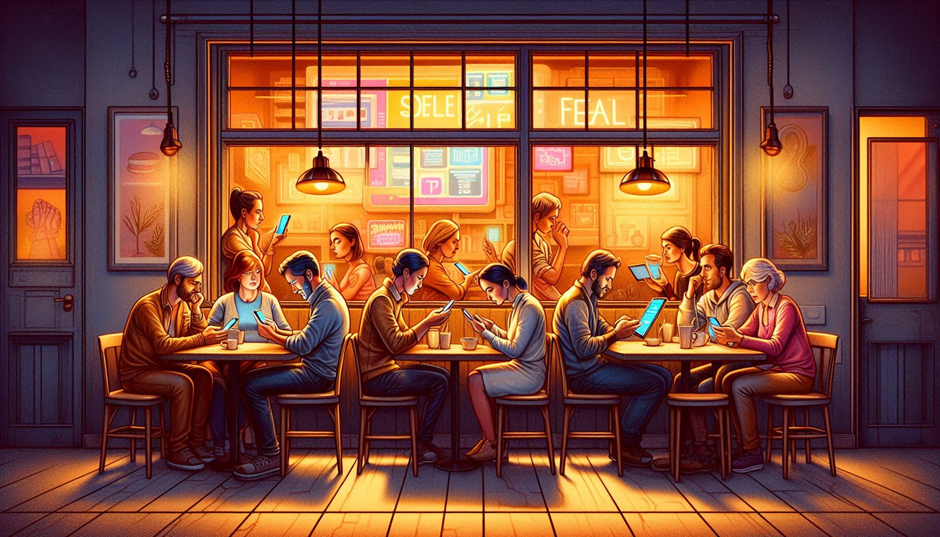
The critical issue is not merely that these cues are absent online, but that habitual immersion in cue-poor environments leads to a deskilling effect. The neural pathways and social muscles required to rapidly detect, interpret, and respond to non-verbal signals require practice to develop and maintain. When individuals, especially during formative developmental stages, spend excessive time interacting through screens, they are not engaging in the complex, real-time exercise of reading faces and bodies. Research in developmental psychology suggests that adolescents who heavily favor digital communication show reduced ability to recognize facial emotions in controlled tests. This represents a direct erosion of empathetic capacity; if one cannot accurately perceive another’s distress, confusion, or joy, an appropriate empathetic response becomes impossible. The phenomenon of “phubbing”—snubbing someone in a physical social setting by focusing on one’s phone—visually encapsulates this disconnect, signaling to the present individual that the digital world holds more compelling cues than their live human expression.
Furthermore, the asynchronous nature of much digital communication allows for editing and curation of responses, removing the spontaneous, empathetic reaction that is central to bonding. In a face-to-face conversation, a wince of shared pain or a smile of genuine delight happens in real time, reinforcing connection. Online, a response can be calculated, delayed, or abandoned, turning interaction into a compositional task rather than an empathetic dance. Over time, this reliance on a controlled, textual medium can diminish one’s comfort and proficiency with the messy, immediate, and cue-rich world of in-person interaction. The individual becomes fluent in the grammar of digital discourse but illiterate in the primal language of embodied human connection, leaving them socially adrift when the screen is removed.
2. The Performance Paradigm: Curated Selves and the Depletion of Authentic Connection
Digital platforms, particularly social media, have transposed social interaction into a paradigm of performance and curation. These environments are structurally designed for broadcast rather than mutual exchange, incentivizing the projection of a polished, highlight-reel self. Users become both the curator and the exhibit, meticulously selecting, filtering, and editing moments of their lives to construct a narrative designed for an audience of peers, acquaintances, and strangers. This performative mode stands in stark opposition to the vulnerability, unpredictability, and mutual disclosure that underpin authentic, deep relationships in real life. The relentless pressure to present an idealized self fosters a psychological split between the curated digital persona and the complex, imperfect offline individual, a state linked to increased anxiety and lowered self-esteem.
This performance culture fundamentally alters the nature of social connection. Interactions become metricized, quantified in likes, shares, and follower counts, reducing the qualitative richness of human rapport to a numerical score. The primary goal shifts from shared understanding and mutual support to gaining validation and amplifying personal brand. Consequently, social skills become skewed towards promotional tactics—crafting catchy captions, taking flattering photos, engaging in strategic commenting—rather than the skills of deep listening, supportive feedback, and navigating conflict. The art of conversation, which requires a delicate balance of speaking and listening, of exploring topics without an immediate agenda, is replaced by the delivery of monologues to a fragmented audience.
Moreover, constant exposure to the curated performances of others distorts social perception and fuels detrimental comparisons. An individual immersed in a stream of peers’ career successes, perfected relationships, and joyful adventures can develop the ingrained belief that their own unedited life, with its mundane struggles and private difficulties, is inadequate. This “compare and despair” dynamic can lead to social withdrawal in the physical world, as the perceived gap between one’s own reality and the polished realities online becomes a source of shame or anxiety. Why engage in the risky vulnerability of a real, unfiltered conversation when one can retreat to the safer, controlled stage of the digital profile? The performance paradigm thus not only teaches inauthentic social presentation but also actively depletes the motivation and self-confidence necessary to engage in authentic, real-world socializing, where one cannot hide behind a filter or edit a statement before it is heard.
3. The Amplification of Social Anxiety and the Retreat to Digital Comfort Zones
For many, digital interfaces do not merely supplement social life; they become a refuge from its perceived demands and threats. The very features that make online interaction appealing—the ability to control self-presentation, the lack of immediate physical judgment, the power to disengage without overt social penalty—can function as a safe harbor for those with nascent or existing social anxieties. However, this refuge often operates as a behavioral trap, reinforcing avoidance and preventing the development of crucial coping skills. In real-life social settings, individuals must learn to manage mild anxiety, tolerate ambiguity, read rooms, and recover from minor gaffes. These are learned competencies, honed through repeated, often awkward, practice. Digital platforms allow users to circumvent this practice entirely, offering a sanitized alternative where anxiety triggers are minimized.
The consequence is a cycle of reinforcement where digital comfort zones enable the atrophy of real-world social muscles. An individual who feels nervous about casual conversation at a party may find it far easier to scroll through social media or text a familiar friend. While this provides immediate relief, it denies them the exposure necessary to learn that their anxiety is manageable and that real interaction can be rewarding. Over time, the real world becomes increasingly intimidating, while the digital world feels increasingly safe and manageable. This dynamic is particularly potent for adolescents, whose social identities and skills are in a critical phase of development. Habituating to conflict-free, asynchronous digital communication can leave them ill-equipped to handle the spontaneous disagreements, subtle rejections, and complex negotiations of teenage social life offline, potentially exacerbating feelings of social inadequacy and isolation.
Furthermore, the nature of online discourse itself can fuel social apprehension. Witnessing or experiencing cyberbullying, public shaming, or vicious comment threads can foster a generalized distrust of social interaction, painting it as a perilous landscape of potential humiliation. This learned apprehension can then spill over into offline settings, making individuals more guarded, less willing to express opinions, and more fearful of negative evaluation. The digital world, rather than serving as a training ground for social confidence, can become a chamber that echoes and amplifies social fears, encouraging retreat rather than engagement. The skill of resilience—bouncing back from a socially awkward moment—fails to develop when the primary mode of interaction allows for deletion, blocking, or silent exit as the first line of defense.
4. The Fragmentation of Attention and the Demise of Deep Conversation
The architecture of digital technology is fundamentally engineered to capture and fragment attention. Notifications, infinite scrolls, hyperlinks, and the sheer volume of available stimuli train the brain for continuous partial attention—a state of perpetual alertness to the next piece of information, the next message, the next update. This cognitive mode is antithetical to the focused, sustained attention required for deep, meaningful conversation. Real-life social skills are not merely about speaking and listening; they are about deep listening, about fully attending to another person with one’s whole cognitive and emotional capacity. This attentional presence is what signals respect, builds rapport, and allows for the exploration of complex ideas and feelings.
The smartphone, as a constant companion, introduces a tangible third party into every physical interaction. Its mere presence on a table, even if face-down, has been shown to reduce the perceived quality of a conversation and the empathy felt between participants, a phenomenon termed the “phone presence effect.” Individuals subconsciously reserve a portion of their attentional resources for the device, waiting for it to buzz or light up. Conversations thus become shallower, trending towards transactional updates or light topics that can withstand interruption, rather than meandering into profound or personal territory. The skill of following a narrative thread, building on another’s point, or sitting comfortably in a reflective silence is eroded by the brain’s conditioned expectation for rapid-fire, novel stimuli.
This erosion of conversational depth has profound implications for social bonding and intellectual exchange. The kind of talk that forges strong friendships, romantic partnerships, and professional collaborations—talk that involves storytelling, debating nuances, sharing fears, and co-creating ideas—requires uninterrupted temporal space and cognitive commitment. When attention is perpetually divided, conversations remain on the surface. People become accustomed to interacting in soundbites and reacting with emojis, losing the stamina and skill for extended dialogue. The capacity for boredom, once a catalyst for rich internal reflection or creative interpersonal engagement, is extinguished by the always-available digital pacifier. As a result, individuals may find themselves physically together yet conversationally alone, connected to distant networks but disconnected from the person in front of them, lacking the very attentional tools needed to bridge that final, crucial gap.
Conclusion
The digital disconnect represents a significant social and psychological challenge of the modern age. The argument that technology inherently weakens real-life social skills is supported by a clear trajectory: from the sensory impoverishment that erodes non-verbal literacy and empathy, to the performance culture that prioritizes curation over authentic connection, to the reinforcement of anxiety-driven avoidance, and finally to the attentional fragmentation that starves deep conversation. This is not a Luddite condemnation of technology, which undoubtedly offers powerful tools for information and logistics. Rather, it is a critical examination of its unintended social costs when use becomes overuse and integration becomes immersion. The skills of face-to-face interaction—reading a room, offering a comforting touch, navigating conflict with grace, sharing an unrehearsed laugh—are not evolutionary relics; they are the bedrock of trust, community, and mental health. To mitigate this disconnect, a conscious recalibration is necessary. It requires individual mindfulness to create tech-free zones and times, institutional promotion of digital literacy that includes awareness of its social impacts, and a cultural revaluation of embodied presence. The goal is not to disconnect from the digital world, but to reconnect with the human one, ensuring that our technological prowess does not come at the cost of our fundamental social humanity.
SOURCES
Abramova, O., et al. (2021). The impact of phubbing on social interaction and relationship satisfaction. Journal of Social and Personal Relationships.
Chotpitayasunondh, V., & Douglas, K. M. (2018). The effects of “phubbing” on social interaction. Journal of Applied Social Psychology.
Misra, S., et al. (2016). The iPhone effect: The quality of in-person social interactions in the presence of mobile devices. Environment and Behavior.
Przybylski, A. K., & Weinstein, N. (2013). Can you connect with me now? How the presence of mobile communication technology influences face-to-face conversation quality. Journal of Social and Personal Relationships.
Richtel, M. (2011). A generation powered by instant gratification. The New York Times.
Sbarra, D. A., et al. (2019). Smartphones, social networking, and loneliness. Journal of Social and Personal Relationships.
Sherman, L. E., et al. (2013). The effects of text, audio, video, and in-person communication on bonding between friends. Cyberpsychology, Behavior, and Social Networking.
Turkle, S. (2015). Reclaiming conversation: The power of talk in a digital age. Penguin Press.
Twenge, J. M. (2017). iGen: Why today’s super-connected kids are growing up less rebellious, more tolerant, less happy—and completely unprepared for adulthood. Atria Books.
Valkenburg, P. M., & Piotrowski, J. T. (2017). Plugged in: How media attract and affect youth. Yale University Press.
HISTORY
Current Version
Dec 17, 2025
Written By
BARIRA MEHMOOD



0 Comments