Introduction: From Reactive Skin to Resilient Skin Ecology
Modern dermatology has evolved from symptom suppression to biological restoration, reshaping how clinicians and formulators approach chronic inflammatory skin conditions. Where once the focus was on reducing redness, itch, or flares through temporary relief strategies — primarily corticosteroids, antibiotics, or antihistamines — contemporary science now recognizes that such methods, while effective in the short term, do not correct the underlying biological disharmony that perpetuates disease.
Conditions like eczema, rosaceous, and chronic sensitivity are no longer viewed as isolated dermatologic issues but as multifactorial systemic reflections of barrier collapse, immune deregulation, microbial imbalance, and neurocutaneous distress. The skin is both a boundary and a mirror, translating internal imbalance, environmental aggression, and emotional stress into visible signs of irritation and inflammation.
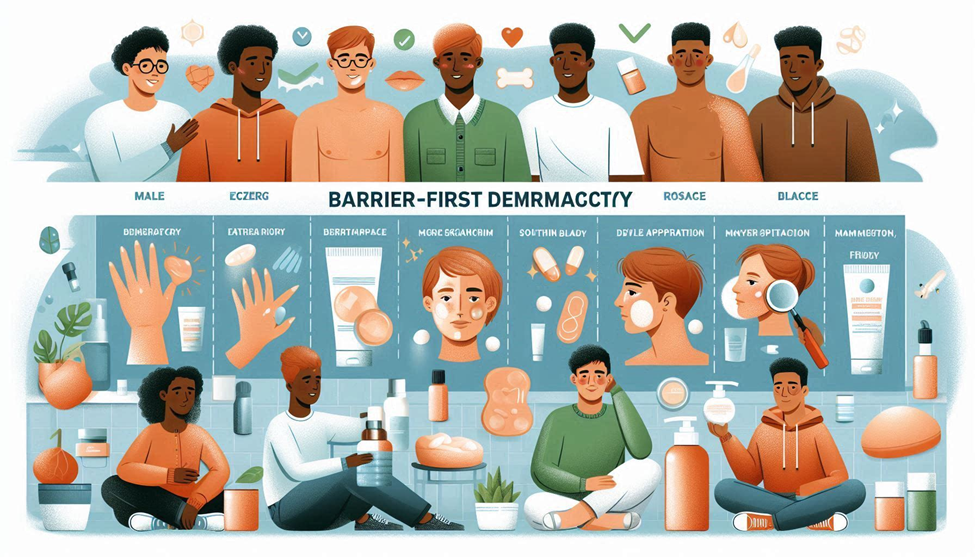
This new understanding gave rise to the “Barrier-First” philosophy, a paradigm that places the epidermal barrier at the center of dermatologic healing. Instead of focusing solely on the suppression of inflammation, this approach seeks to restore the skin’s structural and biochemical resilience — rebuilding lipid organization, normalizing micro biome diversity, recalibrating pH balance, and soothing overactive nerve endings. The skin is treated as a living ecosystem that thrives on harmony among its physical structure (lipids, coenocytes, and hydration), its biochemical environment (enzymes, cytokines, and antioxidants), its microbial inhabitants, and its emotional regulation through the neuroendocrine system.
Barrier-first dermatology, therefore, is not just a therapeutic method but a holistic framework — one that merges dermatologic science with immunology, psychoneuroendocrinology, and micro biome research. It views skin health as dynamic equilibrium, emphasizing long-term repair and adaptability over quick fixes. In this model, healing becomes a process of biological re-education, guiding the skin back toward balance, tolerance, and self-regeneration rather than dependency on pharmacological suppression.
1. The Skin Barrier: Architecture of Protection and Perception
1.1 The Stratum Cornea as a Living Shield
The stratum cornea, once thought to be inert, is now recognized as a dynamic biosensor that regulates hydration, pH, and defense. It is composed of:
- Coenocytes: flattened keratin-rich cells providing mechanical strength.
- Lipid Matrix: creaminess, cholesterol, and free fatty acids forming a waterproof seal.
- Natural Moisturizing Factor (NMF): hygroscopic amino acids that retain moisture.
In eczema or rosaceous, disruptions in this matrix lead to transepidermal water loss (TEWL), reduced hydration, and increased permeability to irritants. The result: neurogenic inflammation, itching, and hypersensitivity.
1.2 Immune and Microbial Symbiosis
A healthy skin barrier hosts a diverse micro biome — bacteria, fungi, and viruses that train the immune system and compete with pathogens. When the barrier breaks, symbiosis occurs: beneficial species like Staphylococcus epidermidis diminish while Staphylococcus aurous and Cut bacterium flourish. This triggers an immune cascade via Toll-like receptors (TLRs) and IL-4/IL-13 cytokine pathways — central to eczema and rosaceous pathogenesis.
1.3 Neurocutaneous Communication
The skin’s sensory neurons detect temperature, pain, and itch. In barrier-compromised conditions, these nerves become hyper reactive — a phenomenon called neurosensory deregulation. Chronic sensitivity thus becomes a state where the skin “overreacts” to benign stimuli like cosmetics, weather, or stress.
Barrier-first dermatology emphasizes neuromodulatory care — calming these nerve endings through soothing lipids, anti-inflammatory peptides, and lifestyle modulation.
2. Eczema: Restoring Lipid Logic
2.1 The Lipid Deficit Hypothesis
In atopic dermatitis (AD), the skin shows a deficiency of creaminess, altered fatty acid ratios, and increased TEWL. The flagging gene mutation, common in eczema, reduces NMF production and weakens corneocyte cohesion. This allows allergens and microbes to penetrate, provoking Th2-dominant inflammation.
2.2 Rebuilding the Barrier
A “Barrier-First” eczema protocol focuses on lipid replenishment, micro biome rebalance, and inflammation control:
- Creamed-Dominant Emollients: Restoring creamed 1 and 3 improves lipid lamellae organization and hydration.
- Phytosphingosine and Sphingolipids: Rebuild natural creamed precursors and signal anti-inflammatory pathways.
- Cholesterol-to-Fatty Acid Ratio (1:1:1): Mimics healthy skin lipid composition, proven to restore function faster.
- Colloidal Oat & Beta-Lucan: Soothe inflammation, reinforce barrier proteins, and support micro biota diversity.
2.3 The Role of the Micro biome
Robotic and post biotic care has emerged as a new dimension:
- Topical Lists (e.g., Vitreoscilla filiformis): Improve eczema severity by modulating innate immunity.
- Periodic Fibers (Insulin, Xylitol): Nourish commensally bacteria.
- Oral Symbiotic: Certain strains like Lactobacillus rhamnosus GG reduce flare frequency.
2.4 Beyond Miniaturization: Neuroimmune Control
Eczema patients often have elevated nerve growth factor (NGF) and substance P, correlating with itch. Lipid formulas combined with neuron-soothing actives such as:
- Palmitoylethanolamide (PEA) — an endocannabinoid analog that reduces sensory irritation.
- Niacin amide (B3) — supports creamed synthesis and barrier repair while calming inflammation.
- Cannabidiol (CBD) — emerging as a neuromodulator that decreases prorates and inflammation.
Barrier-first dermatology integrates these within non-occlusive, micro biome-safe vehicles, ensuring breathability and tolerance.
3. Resaca: Rebalancing the Neurovascular Axis
3.1 The Triple Path physiology
Resaca reflects vascular hyper reactivity, microbial imbalance, and neurogenic inflammation. The skin’s innate immunity becomes over-responsive, producing excessive cathelicidin (LL-37) peptides that trigger vasodilatation and erythematic.
Key triggers: UV radiation, heat, spicy food, alcohol, emotional stress, and barrier-damaging skincare.
3.2 Barrier-First Interventions
- Barrier Recovery Formulations: Restoring lipid integrity reduces reactivity to environmental stressors.
- Low-pH Moisturizers: Help rebalance skin acid mantle, protecting against microbial proliferation.
- Anti-Redness Lipids: Linoleum acid, squalling, and bisabolol strengthen and soothe simultaneously.
3.3 The Neurovascular Calm
Resaca-prone skin has hypersensitive TRPV1 receptors, which react to warmth and irritation. Barrier-first formulations integrate:
- Neurocalming Peptides (Acetyl Tetrapeptide-15): Reduce neurogenic inflammation.
- Vascular Stabilizers: Caffeine and hesperidins methyl chaconne constrict capillaries gently.
- Niacin amide & PEA: Normalize microcirculation and calm reactive flushing.
3.4 Micro biome and Mite Balance
Resaca skin often harbors excess Démodé folliculorum, a mite that triggers inflammation via bacterial symbionts.
Strategies:
- Topical Atelic Acid: Normalizes keratinization and reduces microbial load.
- Robotic Lists: Help recalibrate innate immunity.
- Barrier-Focused Cleansers: Avoid stripping surfactants like SLS and opt for amino acid-based systems.
4. Chronic Sensitivity: The “Silent Epidemic”
4.1 The Rise of Sensitized Skin
The beauty industry’s explosion of active ingredients — retinoid, acids, and exfoliates — has led to a global epidemic of sensitization. Unlike allergies, sensitization is acquired hyper reactivity where the skin becomes chronically irritated, dry, or stinging even without visible inflammation.
Contributors:
- Overuse of exfoliates and actives.
- Harsh cleansers or high-pH products.
- Environmental stress (pollution, UV, blue light).
- Psychological stress increasing cortical and sebum oxidation.
4.2 Rebuilding the Damaged Barrier
A barrier-first approach for sensitized skin focuses on retraining rather than treating:
- Simplify the Routine: 3-step minimalism — gentle cleanses, barrier serum, lipid moisturizer.
- Repair Lipids: Creamed NP, cholesterol, and fatty acids replenish lamellae.
- Lower pH (~5): Encourages enzyme function and micro biome balance.
- Exclude Triggers: Avoid ethanol, essential oils, and fragrance allergens.
4.3 The Psycho dermatologic Link
Stress directly influences barrier integrity. Cortical impairs lipid synthesis, while sympathetic activation increases TEWL. Chronic stress sensitizes coetaneous nerves and heightens inflammation.
Barrier-first care integrates psycho dermatologic tools:
- Mindfulness & breath work reduce neurogenic flare-ups.
- Topical adapt gens (e.g., canella, reship, ashwagandha) help modulate oxidative stress.
- Sleep hygiene supports circadian lipid production and epidermal renewal.
5. Dermatologic Tools: Formulation & Clinical Strategies
5.1 Barrier Repair Biomimicry
Modern barrier-first dermatology uses biomimetic design — replicating the lipid structure and pH of healthy skin:
- Multilamellar Emulsions (MLE): Mimic skin’s lamellar structure for long-term repair.
- Lamellar Gel Networks: Deliver actives while reinforcing lipid baitlayers.
- Physiologic Lipid Ratios (3:1:1) — ceramide: cholesterol: free fatty acids for optimal recovery.
5.2 Intelligent Emollients
Smart emollients now integrate bioactive lipids with sensory modulation:
- Squalling & Jojoba Esters: Lightweight and non-comedogenic.
- Phytoceramides & Omega-3 Esters: Reduce inflammation and reinforce cohesion.
- Lactobacillus Ferments: Strengthen micro biota and improve tolerance.
5.3 In-Clinic Adjuncts
Barrier-first care extends to dermatologic procedures:
- LED Photobiomodulation: Red light promotes healing via ATP up regulation and inflammation control.
- Barrier-Recovery Peels: Using lactic acid, PHA, and lacto bionic acid — non-disruptive exfoliation.
- Barrier Priming before Retinoid or Lasers: Reduces post-treatment reactivity.
6. Nutritional and Internal Support
The skin barrier reflects systemic nutrition:
- Omega-3 & -6 Fatty Acids: Support lipid matrix synthesis.
- Vitamin D & Zinc: Modulate immune balance and antimicrobial peptides.
- Antioxidants (Polyphones, Astaxanthin): Reduce oxidative triggers of inflammation.
- Robotic Nutrition: Gut-skin axis support reduces systemic inflammatory burden.
Functional dermatology integrates these with topical therapy, viewing barrier repair as inside-out restoration.
7. The Future of Barrier-First Dermatology
Emerging directions point toward bioinformatics, AI-driven skin diagnostics, and regenerative lipidomics:
- Skin Micro biome Sequencing: Enables personalized micro biome restoration.
- Artificial Skin Lipid Mapping: Tailors creamed compositions to genetic predispositions.
- Post biotic Biotechnology: Next-gen formulations use bacterial metabolites as immune trainers.
- Neurocosmetic Integration: Formulas that communicate with sensory neurons to calm over activity.
This evolution marks a new era where dermatology meets systems biology — the fusion of neuroscience, immunology, and micro biome science in pursuit of long-term barrier resilience.
Conclusion
Barrier-First Dermatology” transcends the boundaries of conventional treatment — it is a philosophy of dermatologic empathy rooted in the belief that true skin health arises not from correction, but from communication, respect, and restoration. The skin is not merely a surface to be perfected or subdued; it is a living sensory organ, a biological interface through which the body interacts with its internal and external worlds. Every flare, flush, or irritation is not a flaw, but a message — a reflection of the skin’s attempt to restore equilibrium amidst biochemical and environmental chaos.
Eczema, rosaceous, and chronic sensitivity are not failures of the skin but expressions of distress — signals that the intricate dialogue between lipids, immune cells, nerves, and the micro biome has been disrupted. These conditions reveal how deeply interconnected the barrier is with immune resilience, nervous system modulation, and even emotional stability. Healing, therefore, is not achieved through suppression or erasure, but through reconnection — re-establishing dialogue across biological systems so that the skin may once again self-regulate with intelligence and harmony.
The ultimate aspiration of barrier-first care is not merely calmness or clarity, but resilience — skin that adapts, learns, and thrives under changing conditions. Resilient skin can defend, renew, and signal effectively without overreacting; it becomes an intelligent organ of balance. This philosophy ushers in a new era of dermatology — one defined by compassionate science, where treatment merges with understanding, and beauty emerges as the natural consequence of biological integrity. In this future, barrier integrity equals comfort, confidence, and harmony, embodying the union of physiology and empathy — the true essence of modern dermatologic care.
SOURCES
Elias, P. M. (2018). “Structure and function of the skin barrier in atopic dermatitis.” Journal of Allergy and Clinical Immunology.
Porsche, E. (2020). “The role of creaminess in maintaining epidermal integrity.” Experimental Dermatology.
Irvine, A. D. (2019). “Fila grin mutations and barrier dysfunction in eczema.” Nature Reviews Immunology.
Yosipovitch, G. (2021). “Neuroimmune interactions in chronic itch.” Journal of Investigative Dermatology.
Gallo, R. L. (2022). “Cathelicidins and innate immunity in rosaceous.” New England Journal of Medicine.
Luger, T. A. (2017). “The neuroendocrine-immune network of the skin.” Trends in Immunology.
Darlenski, R. (2020). “Barrier repair therapies in dermatology: Mechanisms and clinical implications.” Clinical, Cosmetic and Investigational Dermatology.
Majolica, D. (2019). “Autophagy and lipid homeostasis in the epidermal barrier.” Biochemical ET Biophysical Act – Molecular Cell Research.
Nays, G. (2021). “Micro biome-directed therapies for atopic dermatitis.” Frontiers in Immunology.
Drano, B. (2018). “Skin micro biome and acne/rosaceous path physiology.” British Journal of Dermatology.
Arum, S. (2020). “The impact of omega-3 fatty acids on inflammatory skin diseases.” Nutrients.
Rawlings, A. V. (2017). “Skin miniaturization and barrier repair mechanisms.” International Journal of Cosmetic Science.
Cork, M. J. (2019). “Defective skin barrier in atopic dermatitis: Cause or consequence?” Clinical and Experimental Dermatology.
Kim, B. E. (2021). “Cytokine deregulation in eczema: IL-4 and IL-13 axis.” Journal of Dermatological Science.
Yamasaki, K. (2022). “Démodé and microbial triggers in rosaceous.” Current Opinion in Infectious Diseases.
Drawls, Z. D. (2020). “Evolving strategies in the treatment of sensitive skin.” Dermatologic Therapy.
Choy, E. H. (2018). “Physiologic lipid ratios for barrier repair.” Skin Pharmacology and Physiology.
Tango, O. (2019). “The pH of the skin surface and its impact on barrier homeostasis.” Journal of Dermatological Science.
Liang, Y. (2021). “Role of robotics and postbiotics in skin health.” International Journal of Molecular Sciences.
Misery, L. (2017). “Sensory and emotional dimensions of sensitive skin.” Act Dermato-Venereologica.
Adder, F. A. S. (2020). “Sensitive skin syndrome: Clinical insights and management.” Clinical and Cosmetic Investigational Dermatology.
Pilkington, S. M. (2019). “Photobiomodulation and the skin barrier.” Lasers in Medical Science.
Dena, M. (2021). “Psychological stress and epidermal barrier function.” Archives of Dermatological Research.
Zouboulis, C. C. (2020). “Sebum, micro biome, and inflammation: A triad of barrier modulation.” Experimental Dermatology.
Board, L. J. (2022). “Post biotic biotechnology in dermatology.” Frontiers in Microbiology.
HISTORY
Current Version
Nov 01, 2025
Written By
ASIFA

0 Comments