Introduction
In the modern nutritional landscape, appetite is shaped not only by metabolic need but by the neurobiology of reward, particularly the intricate dopamine circuits that govern motivation, learning, and hedonic eating. Humans evolved reward-driven feeding systems to seek high-energy foods in scarce environments; today, those same circuits are over stimulated by palatable, hyper-processed, energy-dense foods. The result is a profound mismatch: dopamine circuits designed for survival are hijacked by modern food environments, driving compulsive eating, cravings, and reward hyper-responsively.
Dopamine is more than a “pleasure chemical.” It orchestrates wanting, not simply liking. It determines the strength of food cues, the motivational pull of cravings, and the reinforcement of habits that drive automatic eating behaviors. When foods—especially those high in sugar, fat, and flavor intensity—stimulate repeated dopamine spikes, reward pathways adapt. The brain becomes less sensitive to reward, requiring more stimulation to achieve the same level of satisfaction. This neural adaptation parallels mechanisms observed in substance-use disorders, leading some researchers to characterize modern overeating as a form of behavioral addiction rooted in reward dysfunction.
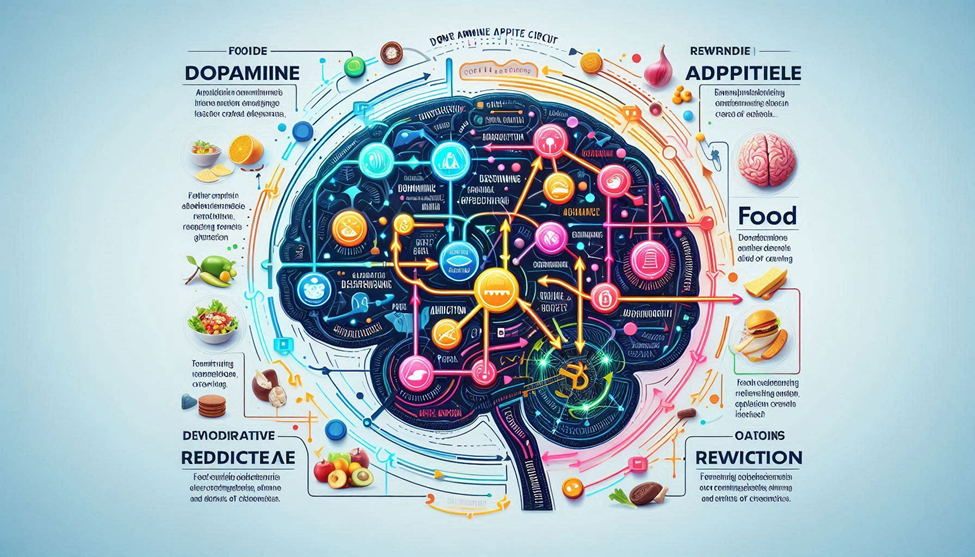
The dopamine–appetite axis interacts with hormonal signals (gherkin, insulin, and lepton), stress physiology (cortical), circadian rhythms, and the gut–brain axis, forming a multi-level regulatory system. When these systems fall out of alignment, appetite becomes deregulated: cravings intensify, satiety signals weaken, and eating transitions from need-based to emotionally or cue-driven.
THE DOPAMINE SYSTEM: FOUNDATIONS OF FOOD REWARD
1.1 Dopamine as a Motivation and Learning Neurotransmitter
Dopamine is most active not during pleasure itself, but in anticipation of reward. In eating behavior, dopamine:
- Drives looking for food
- Enhances the salience of food cues
- Motivates effort toward obtaining food
- Reinforces learned eating behaviors
- Strengthens habitual pathways with repetition
This makes dopamine a behavioral learning signal, shaping when, why, and what we eat.
Unlike uploads—which encode pleasure—dopamine encodes wanting, or incentive salience. This distinction is crucial: a person can intensely want a food that they no longer enjoy, reflecting the deregulation seen in addictive eating.
1.2 The Mesolimbic and Neocortical Reward Circuits
Key pathways include:
- Ventral Segmental Area (VTA) → Nucleus Acumens (Knack)
Core pathway for reward anticipation and reinforcement - Knack → Prefrontal Cortex (PFC)
Governs decision-making, impulse control, long-term goals - Knack → Amygdale
Emotional significance of food cues - Knack ↔ Hippocampus
Memory integration: where and when rewarding foods were consumed
High-dopamine foods increase signaling between these regions, making them more memorable, emotionally charged, and more likely to be consumed habitually.
1.3 Hyper palatable Foods and Dopamine Spiking
Foods engineered for maximal palatability—where combinations of sugar, fat, salt, and flavor enhancers exceed what exists in nature—produce dopamine spikes far greater than whole foods.
Examples include:
- Ice cream
- Fast foods
- Commercial cookies, cakes, chocolates
- Pizza
- Chips and crunchy snacks
- Sweetened beverages
- Energy-dense ultra-processed foods (UPFs)
These foods generate dopamine surges comparable to addictive behaviors, such as gambling or nicotine, creating an unusually strong reinforcement loop.
1.4 Dopamine Down regulation and Tolerance
Repeated dopamine spiking drives compensatory adaptations:
- Reduced dopamine receptor availability (especially D2 receptors)
- Lowered baseline dopamine signaling
- Increased reward threshold
- Decreased sensitivity to normal, whole-food rewards
- Heightened reactivity to cues associated with palatable foods
These adaptations mirror those observed in drug addiction. As the brain becomes less sensitive, people require more stimulation to feel satisfied, intensifying cravings and overeating.
THE NEUROBIOLOGY OF FOOD ADDICTION
2.1 Addictive Eating vs. Normal Hedonic Eating
Hedonic eating is normal—humans enjoy food.
Addictive eating involves:
- Loss of control
- Eating despite negative outcomes
- Persistent cravings
- Compulsion
- Increasing tolerance
- Withdrawal-like emotional states (irritability, anxiety) when abstaining
Dopamine-driven reinforcement, paired with emotional and cue-based triggers, leads to deeply ingrained patterns.
2.2 The DSM-5 and Food Addiction Debate
While food addiction is not formally recognized in the DSM-5, the Yale Food Addiction Scale (YFAS) provides diagnostic-like criteria paralleling substance use disorders, including:
- Impaired control
- Persistent desire to cut down
- Excessive time spent obtaining food
- Continued use despite harm
- Tolerance
- Withdrawal
A growing body of evidence supports the neurobiological overlap between overeating and addictive behaviors.
2.3 Sugar, Fat, and Dopamine: The Triple-Hit Pathway
Hyper palatable foods stimulate dopamine through multiple mechanisms:
- Sugar rapidly elevates dopamine via sweet taste receptors and insulin–dopamine relationships.
- Fat activates upload pathways and enhances dopamine release.
- Salt + maim increase sensory reward and eating speed.
When these elements combine, the reward response becomes exponential, not additive.
2.4 Cue-Induced Eating
Environmental cues—images, smells, locations, and packaging—activate dopamine anticipation pathways before food is consumed.
This explains why:
- Seeing a bakery triggers hunger
- TV ads spark cravings
- The smell of popcorn increases appetite even when full
Dopamine is released in expectation, making cues extremely powerful behavioral drivers.
HORMONAL REGULATION OF DOPAMINE AND FOOD REWARD
Dopamine appetite circuits do not operate in isolation. They are tightly integrated with peripheral metabolic hormones that signal energy status, nutrient availability, stress, and circadian timing. These hormones influence dopamine release, receptor sensitivity, reinforcement learning, and reward perception.
3.1 Gherkin: The Hunger Hormone That Primes Dopamine Reward
Gherkin, released primarily from the stomach during fasting, is the only hormone that increases appetite—and one of the most potent stimulators of dopamine pathways.
Mechanisms:
- Travels to the brain and activates the VTA, increasing dopamine neuron firing.
- Enhances incentive salience, making food cues more appealing.
- Strengthens learning related to high-reward foods.
- Increases consumption of sugar- and fat-rich foods.
Clinical Relevance:
- Elevated gherkin in stress, sleep deprivation, and caloric restriction increases cravings for hyper palatable foods.
- Emotional eaters often display exaggerated gherkin responses, intensifying cue-triggered cravings.
3.2 Lepton: The Satiety Hormone That Dampens Reward
Lepton, released from adipose tissue, inhibits food reward circuits.
Lepton reduces dopamine signaling by:
- Lowering VTA dopamine neuron activity
- Reducing Knack dopamine release
- Diminishing motivation for high-calorie foods
However, in obesity, lepton resistance develops.
Lepton resistance leads to:
- Impaired satiety responses
- Heightened reward sensitivity
- Persistent cravings despite adequate energy stores
- Greater cue-reactivity to food environments
This is why individuals with obesity may report intense desire for palatable foods even when physiologically full.
3.3 Insulin: A Regulator of Dopamine Reuptake and Preference
Insulin acts in the brain to regulate eating behavior and reward processing.
Key effects include:
- Enhancing dopamine transporter (DAT) activity → increasing dopamine clearance
- Reducing reward sensitivity to sugary foods
- Improving decision-making in the PFC
- Limiting impulsive eating
In insulin resistance:
- DAT function decreases
- Dopamine persists longer in the synapse
- Reward-seeking intensifies
- Sweet preference increases
This explains why pre-diabetes and type 2 diabetes is associated with stronger cravings and deregulated appetite.
3.4 Cortical and Stress: Potent Amplifiers of Reward Eating
Chronic stress elevates cortical, which profoundly alters dopamine circuits.
Cortical increases:
- Motivation for high-calorie foods
- Dopamine release in the Knack
- Emotional eating
- Preference for sugar and fat
Mechanisms:
- Heightens gherkin release
- Weakens inhibitory PFC control
- Enhances cue-triggered cravings
- Activates amygdale fear-reward pathways
This forms the foundation of stress-induced overeating, a key driver of modern obesity.
3.5 GLP-1, PYY, and Dopamine Suppression
Gut-derived hormones such as GLP-1 and PYY naturally restrain food reward.
GLP-1 (Glucagon-Like Peptide 1):
- Reduces dopamine release
- Slows eating speed
- Increases satiety
- Reduces motivation for high-calorie foods
This is why GLP-1 agonists (e.g., semaglutide, liraglutide) reduce cravings, compulsive eating, and food noise.
PYY:
- Released post-meal
- Reduces reward-driven eating
- Improves PFC inhibitory control
Low PYY levels, often seen in ultra-processed diets, impair satiety and reward suppression.
STRESS, EMOTION, AND THE REWARD–APPETITE LOOP
Stress is one of the most potent modulators of dopamine appetite circuits, shifting eating behavior from need-driven to emotionally driven.
4.1 The Stress-to-Craving Pathway
Chronic stress produces:
- High cortical
- Elevated gherkin
- Increased dopamine release
- Reduced frontal lobe control
Over time, food becomes a form of emotional regulation:
- Cortical triggers cravings
- Dopamine provides temporary relief
- The cycle repeats
This rewires the brain toward habitual stress eating, particularly for high-sugar, high-fat foods.
4.2 Emotional Eating and the Amygdale–Reward Fusion
The amygdale, which processes emotion, interacts directly with dopamine circuits.
During stress, the amygdale becomes hyperactive:
- Heightening emotional significance of food
- Strengthening memory for emotionally rewarding foods
- Increasing eating as a coping strategy
This transforms food into a self-soothing tool, reinforcing neural dependencies similar to addictive behaviors.
4.3 Trauma, Attachment, and Reward Deregulation
Individuals with trauma histories or insecure attachment styles may exhibit altered dopamine responses:
- Lower baseline dopamine
- Higher sensitivity to reward cues
- Stronger drive for emotional comfort foods
Trauma can blunt the prefrontal cortex, decreasing impulse control and increasing vulnerability to compulsive eating.
4.4 Sleep Deprivation and Dopamine Hyper-Responsively
Lack of sleep triggers:
- Elevated gherkin
- Decreased lepton
- Increased cortical
But critically, it also:
- Increases reward response to high-calorie foods
- Enhances Knack activity
- Weakens PFC decision-making
Sleep deprivation therefore mimics a “dopamine sensitized” state, dramatically increasing cravings.
THE GUT–BRAIN AXIS AND DOPAMINE BIOLOGY
The gut micro biome contributes substantially to reward processes, craving biology, and dopamine signaling.
5.1 Microbial Metabolites Influence Dopamine Synthesis
Gut bacteria produce:
- Tyrosine precursors
- SCFAs (butyrate, acetate)
- Retroactive metabolites influencing dopamine neurons
Some microbes increase dopamine precursor availability, enhancing reward drive.
5.2 Symbiosis and Hyper palatable Food Cravings
Microbial imbalance leads to:
- Increased inflammation
- Increased gut permeability
- Altered dopamine synthesis
- Increased emotional reactivity
- Higher preference for sugary foods
Certain bacteria prefer simple sugars, and may influence cravings to promote their own survival.
5.3 SCFAs and Reward Regulation
SCFAs, particularly butyrate, enhance:
- Inhibitory PFC control
- Dopamine receptor expression balance
- Satiety hormone release
High-fiber diets therefore regulate food reward through the micro biome.
5.4 The Enteric Nervous System and Vaal Modulation of Reward
Signals from the gut travel via the vague nerve to the brain, influencing:
- Motivation
- Emotional state
- Reward sensitivity
High-fat, high-sugar foods alter vigil tone, creating a loop of reward deregulation.
5.5 Inflammation, Cytokines, and Dopamine Disruption
Inflammation reduces dopamine availability by:
- Increasing microglia activation
- Reducing dopamine synthesis
- Altering reward processing
- Weakening motivation for healthy behaviors
DOPAMINE, HABITS, AND THE NEUROSCIENCE OF CRAVING LOOPS
Cravings are not random. They emerge from a structured neurological cycle encoded by dopamine-learning pathways. Understanding this cycle allows clinicians to apply targeted interventions that reshape eating behaviors at the neural level.
6.1 The Cue → Craving → Response → Reward Loop
All habit-forming behaviors follow a predictable neuroscience pattern:
- Cue — external or internal trigger
- Craving — dopamine-driven anticipation
- Response — behavior taken to obtain the reward
- Reward — dopamine release reinforcing the pattern
Food examples:
- Cue: smell of baking bread
- Craving: sudden desire to eat
- Response: purchase and consume
- Reward: dopamine surge → memory encoded
With repetition, the dopamine spike shifts earlier—from the reward itself to the cue. This is the hallmark of habitual eating.
6.2 The Transition from Goal-Directed to Habitual Eating
Goal-directed eating involves conscious thought, intention, and decision-making.
Habitual eating bypasses the prefrontal cortex and is driven by:
- The dorsal striatum
- Strong cue-reward associations
- Automaticity
Once eating becomes habitual:
- Hunger becomes irrelevant
- Emotions or environmental stimuli dominate behavior
- Dopamine surges occur before consumption
6.3 Neurological Strengthening of Craving Pathways
Repeated engagement with highly palatable foods:
- Increases dendrite spine density in reward regions
- Strengthens synaptic connectivity
- Enhances cue-triggered dopamine firing
- Weakens PFC inhibitory circuits
This shift mirrors addiction-related neuroplasticity.
6.4 How Food Manufacturers Exploit Habit Loops
Ultra-processed foods are designed to:
- Melt quickly (increasing dopamine speed)
- Maximize crunch-sound reward
- Trigger multisensory anticipation
- Provide fast glucose absorption (reward immediacy)
- Deliver flavor enhancers that exaggerate hedonic sensations
This engineering reshapes neural circuits toward compulsive consumption.
INDIVIDUAL DIFFERENCES IN DOPAMINE AND CRAVING BIOLOGY
Not all people are equally sensitive to food reward. Genetic and developmental factors strongly influence dopamine circuitry.
7.1 Genetic Variations: DRD2, COMT, and Reward Sensitivity
DRD2 (Dopamine Receptor D2 gene)
Low-expression variants correlate with:
- Reduced dopamine receptor availability
- Higher reward seeking
- Emotional eating
- Obesity risk
- Greater response to hyper palatable foods
COMT (Catechu-O-Methyltransferase)
Affects dopamine breakdown rate.
- COMT Met/Met: slower breakdown → more reward sensitivity
- COMT Val/Val: faster breakdown → decreased reward responsiveness → compensatory overeating
7.2 Developmental Programming of Reward Circuits
Early-life exposures shape dopamine pathways permanently:
- Childhood sugar overexposure increases reward responsively
- Parental feeding styles modify emotional-eating pathways
- Trauma and unpredictability sensitize reward reactivity
- Maternal stress during pregnancy alters fetal dopamine architecture
7.3 Differences in Food Reward
Women generally display:
- Higher emotional-eating tendencies
- Stronger cue-induced cravings
- Greater stress-related reward seeking
- More powerful hormonal modulation of reward circuits
Men show:
- Higher baseline dopamine
- Greater drive toward high-fat cravings
- Stronger visual cue sensitivity
7.4 Age and Reward Circuit Sensitivity
Children & adolescents:
- Heightened dopamine reactivity
- Greater vulnerability to habit formation
- Stronger learning from sugar rewards
Older adults:
- Lower baseline dopamine
- Higher motivation for palatable foods to compensate
METABOLIC CONSEQUENCES OF REWARD DYSREGULATION
Chronic overstimulation of dopamine pathways has profound metabolic consequences.
8.1 Increased Caloric Intake and Hyperplasia
Dopamine-driven eating often occurs independently of hunger:
- Craving overrides physiological satiety
- Larger portions needed due to reward tolerance
- Increased eating frequency
- Reduction in inter-meal intervals
8.2 Insulin Resistance and Reward Overlap
Excessive reward eating contributes to:
- Adiposity
- Elevated inflammation
- Impaired insulin signaling
Insulin resistance decreases dopamine clearance, causing reward hypersensitivity, creating a vicious cycle.
8.3 Lepton Resistance and Reward Amplification
High lepton should reduce reward seeking—but in lepton resistance:
- Appetite increases
- Reward sensitivity increases
- Fat mass continues to rise
This amplifies compulsive eating behaviors.
8.4 Circadian Deregulation of Food Reward
Night eating increases dopamine sensitivity:
- The brain interprets nighttime eating as “rare high-reward opportunity”
- Circadian clocks lose alignment
- Evening cravings intensify due to lower PFC control
Nighttime eating is one of the strongest predictors of:
- Metabolic syndrome
- Obesity
- Impaired glucose tolerance
HOW TO REWIRE DOPAMINE CIRCUITS: SCIENTIFICALLY VALID STRATEGIES
Reversing addictive eating is possible through targeted neurobehavioral and nutritional interventions. These strategies reshape neuroplasticity, restore hormonal alignment, and restore sensitivity to natural-food rewards.
9.1 Dopamine Reset: Reducing Stimulation Without Full Abstinence
A “dopamine reset” involves:
- Reducing exposure to hyper palatable foods
- Slowing eating speed
- Removing intense flavor stimuli
- Increasing whole-food density
This gradually restores receptor sensitivity.
9.2 Protein Anchoring to Stabilize Reward Circuits
High-quality protein:
- Stabilizes blood sugar
- Reduces dopamine volatility
- Increases PYY and GLP-1
- Lowers gherkin
A 30–35 g protein breakfast significantly reduces cravings later in the day.
9.3 Fiber and SCFA Optimization
Periodic fibers support:
- Gut–brain dopamine balance
- Butyrate-mediated PFC strengthening
- Reduced reward sensitivity
Aim for:
- 30–40 g/day fiber
- 7–12 g prebiotics
- Fermented foods daily
9.4 Reduce Dopamine Richness: Tempo, Texture, Tempo
Strategies include:
- Eating slower to reduce dopamine rate
- Avoiding foods that melt instantly
- Reducing combinations of sugar + fat + salt
This weakens the reinforcement loop.
9.5 Cue Disruption and Strategic Exposure Control
Remove or modify cues:
- Keep trigger foods out of sight
- Avoid walking by familiar dopamine-linked environments
- Change routines associated with eating
Even small cue changes dramatically reduce cravings.
9.6 Strengthening the Prefrontal Cortex (PFC)
Activities that rebuild inhibitory control:
- Sleep optimization
- Mindfulness training
- Deep breathing
- Cold exposure
- Resistance training
- Omega-3 supplementation
- Intermittent fasting (moderate, not extreme)
These enhance PFC–reward circuit connectivity.
9.7 Stress-Regulation Protocols
Because stress amplifies dopamine-driven eating, stress management is indispensable.
Key interventions include:
- Yoga
- Breath work
- Nature exposure (“green dopamine”)
- Adapt gens (ashwagandha, rhodiola)
- Therapy for trauma-driven eating
- Consistent meal timing
9.8 Chrononutrition: Eating in Harmony with Dopamine Rhythms
Dopamine sensitivity is highest in the morning and lowest at night.
Implication:
- Eat larger meals earlier
- Avoid nighttime high-reward foods
- Preserve circadian alignment
9.9 Using Habits and Identity-Based Eating to Reinforce Change
Identity-based rewiring is one of the most effective approaches:
Instead of saying:
“I need to stop eating this,”
the mindset shifts to:
“I am someone who nourishes my brain and body.”
Identity rewiring stabilizes behavioral change at the neurocircuit level.
ADVANCED STRATEGIES FOR DOPAMINE CIRCUIT REWIRING
10.1 Neuroplasticity-Based Interventions
- Cognitive Behavioral Therapy (CBT):
- Reframes thought patterns and reduces cue-reactive eating.
- Strengthens PFC inhibitory circuits to counteract Knack hyperactivity.
- Mindfulness-Based Eating Awareness Training (MB-EAT):
- Enhances awareness of hunger/satiety signals.
- Reduces automaticity of eating habits.
- Dampens amygdale-driven reward over activation.
- Intermittent Reward Fasting (IRF):
- Structured, moderate restriction of hyper palatable foods.
- Prevents total deprivation, maintaining dopamine balance.
- Gradually recalibrates reward thresholds.
10.2 Pharmacologic Adjuncts
- GLP-1 receptor agonists: Reduce dopamine hyper-responsiveness, enhance satiety, and suppress reward craving.
- Dopamine-modulating compounds (e.g., bupropion): Target compulsive eating in combination with behavioral strategies.
- Naltrexone-bupropion combination: Modulates upload and dopamine circuits to reduce hedonic eating.
10.3 Nutritional Interventions for Circuit Optimization
- High-fiber, polyphone-rich diets: Promote SCFA production and reduce inflammation.
- Balanced macronutrients: Steady protein, low glycolic load carbohydrates, and healthy fats stabilize dopamine signaling.
- Omega-3 fatty acids: Improve PFC connectivity and receptor sensitivity.
- Fermented foods and robotics: Support gut–brain–dopamine axis.
10.4 Lifestyle Interventions
- Sleep hygiene: Restores hormonal balance and PFC inhibitory control.
- Regular physical activity: Enhances dopamine receptor density, stabilizes reward processing, and reduces visceral fat.
- Stress management: Yoga, meditation, breath work, and adaptive therapy mitigate cortical-induced reward hyper activation.
10.5 Rewiring Cravings: Integrated Approach
- Reduce hyper palatable stimulation: Avoid ultra-processed foods.
- Stabilize metabolic signals: Protein, fiber, and whole foods.
- Strengthen executive control: Mindfulness, CBT, PFC-targeted exercises.
- Regulate stress and sleep: Cortical and gherkin modulation.
- Reinforce identity and habits: Self-perception and environmental cues.
Outcome: Reward circuits gradually recalibrate. Cravings diminish, food choice autonomy improves, and habitual overeating decreases.
Conclusion
Dopamine appetite circuits form the neurobiological foundation of cravings, food reward, and, in extreme cases, addictive eating behaviors. Hyper palatable foods, environmental cues, and chronic stress hijack these circuits, creating compulsive desire, altered satiety, and persistent overeating. Dopamine does not signal pleasure alone but encodes anticipation, incentive salience, and motivational drive, which are shaped by genetics, early life programming, sex, and age. Hormonal regulators such as gherkin, lepton, insulin, cortical, GLP-1, and PYY intricately modulate these circuits, integrating peripheral energy status with central reward pathways. Disruption in these regulatory networks underlies craving deregulation, overeating, and obesity risk, linking metabolic and psychological health in a feedback loop mediated by the mesolimbic, neocortical, amygdale, and hippocampus networks.
Rewiring dopamine circuits requires a multi-level, evidence-based approach. Behavioral interventions, including mindfulness, cognitive-behavioral therapy, and habit restructuring, strengthen PFC inhibitory control and disrupt cue-driven compulsions. Nutritional strategies—emphasizing protein, fiber, polyphones, omega-3 fatty acids, and whole foods—stabilize hormonal signals, gut–brain communication, and reward sensitivity. Lifestyle optimization, encompassing sleep, stress management, physical activity, and circadian-aligned eating, further enhances circuit recalibration. Pharmacologic agents, where indicated, may assist by modulating dopamine, upload, and GLP-1 pathways. Over time, integrated application of these strategies restores homeostatic and hedonic balance, diminishes compulsive cravings, and empowers autonomous, health-aligned eating behaviors.
Understanding and leveraging dopamine appetite circuits is critical for clinicians, nutritionists, and behavioral scientists. By addressing the neural, hormonal, metabolic, and environmental contributors to reward deregulation, interventions can target root mechanisms rather than symptoms alone. This neurobiological informed framework enables sustainable dietary adherence, reduced metabolic risk, and improved psychological well-being, offering a precision approach to craving management in the modern food environment.
SOURCES
Volker et al. (2011) – Reward circuitry in food and drug addiction.
Bridge & Robinson (2016) – Dopamine, “wanting” vs. “liking.”
Slice et al. (2008) – Neural predictors of overeating.
Davis et al. (2011) – Food addiction and YFAS.
Kenny (2011) – Dopamine signaling and compulsive eating.
Berthoud (2012) – Homeostatic and hedonic control of eating.
Gherkin et al. (2005) – Gherkin and dopamine reward pathways.
Schwartz et al. (2000) – Lepton modulation of VTA.
Figlewicz et al. (2003) – Insulin signaling in reward circuits.
Adam & Peel (2007) – Stress and reward-driven eating.
Holden et al. (2012) – Cue-induced reward responses.
Fulton et al. (2006) – Sugar, fat, and dopamine synergism.
Volker et al. (2012) – D2 receptor down regulation in obesity.
Carnell et al. (2012) – Genetic differences in food reward.
Slice et al. (2010) – Reward deficiency theory.
Kaye et al. (2013) – Neurobiology of appetite and cravings.
Davis & Carter (2014) – Emotion, stress, and overeating.
Cummings et al. (2001) – GLP-1 and PYY satiety modulation.
Sainsbury & Zhang (2010) – Lepton resistance in diet-induced obesity.
Sullivan et al. (2015) – Gut micro biome and reward regulation.
Berthoud et al. (2017) – Gut–brain communication in appetite.
Volker & Wise (2005) – Addiction parallels in overeating.
Farr et al. (2015) – Inflammation, dopamine, and metabolic risk.
Messina et al. (2017) – Chrononutrition and reward sensitivity.
Robinson et al. (2019) – Neuroplasticity and craving rewiring interventions.
HISTORY
Current Version
Nov 25, 2025
Written By
ASIFA
0 Comments