Introduction
In an age characterized by digital saturation, urban sprawl, and relentless noise, the human spirit yearns for respite. For Muslims, this search for tranquility is not merely a contemporary wellness trend but is deeply embedded in the prophetic tradition. The Sunnah of Prophet Muhammad (peace be upon him) provides a profound blueprint for engaging with the natural world, presenting mountains, gardens, deserts, and open landscapes not as mere backdrops but as sacred spaces imbued with barakah (divine blessing) and potential for spiritual elevation. This article explores the Islamic paradigm of natural spaces as venues for worship, contemplation, and psychological restoration, arguing that the prophetic practice of seeking solace in nature is a holistic Sunnah addressing the needs of the soul, mind, and body. By examining Quranic verses, authentic hadiths, and the practices of the early Muslim community, we will delineate a theology of nature in Islam and its practical applications for modern life.
The Quranic Foundation: Nature as Ayat
The Islamic engagement with nature begins with the Quranic concept of ayat (signs). The natural world is repeatedly presented as a tapestry of signs pointing to the Divine. The Quran does not view creation as a random occurrence or mere matter, but as a deliberate act of God, filled with purpose and intelligibility.
“Indeed, in the creation of the heavens and the earth and the alternation of the night and the day are ayat for those of understanding” (Quran, 3:190).
Mountains, rivers, trees, and the cycles of seasons are all ayat to be observed, pondered, and through which one can attain taqwa (God-consciousness). This perspective establishes a sacred relationship between the believer and the environment. Nature is a “book” to be read alongside the revealed Book. Elsayed (2018) notes that this Quranic worldview fosters an attitude of reverence rather than domination, where the believer is a khalifah (steward) tasked with both benefiting from and protecting the natural order.
The Quran often uses natural imagery to describe spiritual states and divine rewards. The Garden (Jannah) is the ultimate abode, described with flowing rivers, lush foliage, and perfect harmony. This is not merely allegory but an affirmation of the inherent goodness and desirability of natural beauty and tranquility. Furthermore, specific natural locales are mentioned for their significance, such as Mount Sinai (Tur) and the blessed olive tree (Quran 24:35). This foundational Quranic principle transforms every encounter with nature from a mundane act into a potential moment of remembrance (dhikr) and cognitive reflection (tafakkur).
The Prophetic Model: Solitude, Worship, and Connection
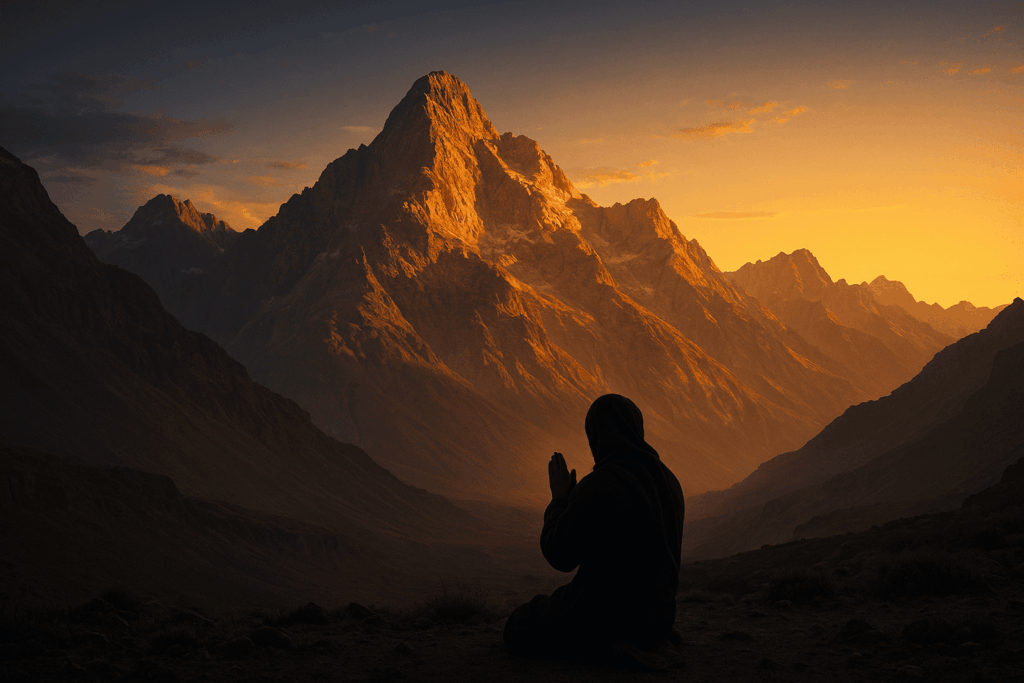
The life of Prophet Muhammad (ﷺ) provides a practical manual for engaging with natural spaces. From the onset of his prophethood, mountains and caves were integral to his spiritual journey. The seminal event of revelation occurred in the Cave of Hira on Jabal al-Nour (the Mountain of Light). This was not a random choice but part of a pre-revelatory practice of tahannuth – spending days in solitary devotion away from the distractions of Makkah. The mountain cave provided the physical solitude and mental clarity necessary for receiving the first words of the Quran.
This practice continued throughout his life. The Prophet (ﷺ) frequently sought refuge in natural spaces for prayer, meditation, and seeking divine assistance. Before the pivotal Battle of Badr, he supplicated in a small shelter on the battlefield, earnestly seeking Allah’s help. He would often go to the mountain of Uhud, expressing love for it because it was a mountain that loved him and whom he loved in return (Bukhari). This statement transcends mere geography; it indicates a relational, almost reciprocal bond between the Prophet and a natural feature, imbuing it with spiritual and emotional significance.
The Prophet’s immersion in nature was also routine. Abdul-Rahman (2020) highlights that his daily life involved constant contact with the elements: walking on sand, gazing at the sky, tending to animals, and planting trees. He encouraged the cultivation of gardens, even stating, “If a Muslim plants a tree or sows seeds, and then a bird, or a person or an animal eats from it, it is regarded as a charitable gift for him” (Bukhari). This hadith ties agricultural and environmental action directly to ongoing charity (sadaqah jariyah), incentivizing the creation and preservation of green spaces.
His prayers and supplications were often infused with natural phenomena. He would pray for rain (istisqa), observe the new moon, and use elements like water, leaves, and the direction of the wind for purification and orientation. The Sunnah, therefore, normalizes a life lived in conscious connection with the natural rhythm, not in alienation from it.
Mountains as Places of Strength and Revelation
Mountains hold a special place in the Islamic tradition. In the Quran, they are depicted as pegs that stabilize the earth (78:7) and as entities that, in their own way, engaged in tasbih (glorification of God) (21:79). The Prophet’s relationship with mountains underscores their role as sites for spiritual retreat, strategic planning, and divine communication.
The choice of Cave of Hira is instructive. Its elevation required physical effort to reach, symbolizing the struggle (jihad) necessary for spiritual growth. Its seclusion allowed for a detachment from societal pressures, enabling deep introspection and connection with the Divine. Modern psychology corroborates the benefits of such “retreats,” noting how exposure to elevated, quiet natural environments can reduce cortisol levels, enhance focus, and promote a sense of awe—an emotion closely linked to spiritual experience. Kaplan & Kaplan (1995) developed Attention Restoration Theory, positing that natural environments restore depleted cognitive resources, a phenomenon the Prophet (ﷺ) intuitively engaged in.
Mountains also served as places of refuge and protection. The Hijrah (migration) to Madinah involved travel through mountainous terrain, which provided cover from pursuit. Later, during the Battle of the Trench, the mountain of Sal’ formed a natural part of Madinah’s defense. Thus, mountains in the Sunnah represent both spiritual and physical fortresses—places where faith is fortified, and the community is safeguarded. For the contemporary believer, this translates into seeking out elevated natural spaces for periods of intense prayer, Quranic recitation, and strategic life planning, away from the incessant demands of modern connectivity.
Gardens as Spaces of Cultivation and Serenity
If mountains symbolize struggle and revelation, gardens in the Sunnah symbolize cultivation, bounty, and serene enjoyment. The Arabic word for garden, jannah, is the same as the word for Paradise, creating a powerful symbolic link. The Prophet (ﷺ) took great interest in the physical gardens of this world, such as the garden of a companion named Abu Talha, which he frequently visited for its beauty and peace.
Gardening and agriculture are elevated acts of worship. The aforementioned hadith on planting trees establishes a theology of environmental stewardship where every act of nurturing life yields continuous reward. He also said, “Never does a Muslim plant a tree except that he has the reward of charity given to him for what is eaten from it, what is stolen from it, what is taken from it, what the birds eat from it, and what the wild animals eat from it” (Muslim). This incentivizes not only planting but also a generous, non-possessive attitude toward the produce, sharing it with all creatures.
The garden is also a space for social and family bonding. The Prophet (ﷺ) would take his family to gardens for leisure and picnics. Khan (2019) observes that these practices sanctify wholesome recreation (tarwih) and family time spent in nature, countering a purely ascetic or ritualistic understanding of faith. The garden becomes a mihrab (prayer niche) of a different kind—one for cultivating gratitude (shukr), observing the intricate beauty of creation, and strengthening communal ties.
In urban planning and personal lifestyle, this Sunnah encourages the creation and frequent visitation of green spaces. Community gardens, home vegetable patches, balcony planters, and the preservation of public parks become acts of Sunnah revival, contributing to ecological health, food security, and psychological well-being.
The Psychological and Spiritual Barakah: An Islamic Ecology of Well-being
The barakah (blessing) in natural spaces, as evidenced in the Sunnah, manifests in tangible psychological and spiritual benefits that modern science is only beginning to quantify. The Islamic concept of fitrah (primordial human nature) posits that humans are born in a state of natural inclination toward truth, purity, and harmony. Natural environments, being uncorrupted by human distortion, resonate with this fitrah, facilitating a return to one’s essential self.
Spiritually, nature acts as a catalyst for dhikr (remembrance) and tafakkur (contemplation). The vastness of a mountainscape prompts humility; the intricate design of a leaf inspires awe at God’s wisdom; the flowing water symbolizes divine mercy and purity. This form of contemplation is a bridge between the sensory experience and spiritual realization, a practice the Quran repeatedly enjoins.
Psychologically, the benefits are profound. Studies in environmental psychology consistently demonstrate that exposure to nature reduces stress, anxiety, and symptoms of depression. Bratman et al. (2015) found that time in natural settings decreases rumination—a pattern of negative, self-referential thought linked to depression. The Sunnah of seeking solitude in nature, such as the khalwah (seclusion) practiced by the Prophet (ﷺ), directly facilitates this mental clearing. Furthermore, the act of walking (masy) through natural terrain, a common feature of the Prophet’s life, combines physical exercise with “soft fascination,” allowing the mind to rest and restore executive function.
This synthesis forms an “Islamic ecology of well-being,” where the spiritual, psychological, and environmental are inextricably linked. The barakah is not an abstract concept but a lived experience of increased peace, clarity, and spiritual receptivity that arises from aligning one’s lifestyle with this prophetic pattern.
Reviving the Sunnah in the Modern Context
In a world facing an epidemic of loneliness, digital overload, and ecological crisis, reviving the Sunnah of natural spaces is both a spiritual imperative and a practical necessity. This revival must occur on multiple levels:
- Individual Practice: Muslims can intentionally incorporate “nature Sunnahs” into their routines. This can include performing dawn (Fajr) prayer in a park, taking regular walks without headphones to engage in dhikr, planting and tending to greenery, and scheduling monthly or quarterly retreats to hike in mountains or forests. Following the Prophet’s example, one can use these moments for sincere supplication (du’a), as he often made profound du’as in open spaces.
- Family and Community Life: Communities can organize family hiking trips, gardening projects at mosques, and clean-up efforts in local natural areas (ihsan to the environment). Mosques, traditionally centers of communal life, can be designed or retrofitted to include gardens, courtyards with water features, and green roofs, making nature an integral part of the religious experience.
- Educational Integration: Islamic schools and weekend programs can move classes outdoors, teach environmental science through the lens of Quran and Sunnah, and organize camping trips. This fosters a generation that sees nature as a masjid (place of prostration) and a source of divine signs.
- Urban Planning and Advocacy: Muslim communities and scholars can advocate for equitable access to green spaces in urban planning, supporting policies that protect forests, mountains, and waterways. This is an act of iman (faith) and a fulfillment of the trust (amanah) of stewardship. Scholars like Ozdemir (2003) have called for a robust Islamic environmental ethic derived from these very sources, moving beyond theory to community-based action.
- Ecological Justice: The principle of mizan (balance) and prohibition of waste (israf) inherent in the Islamic tradition provide a framework for sustainable living. Protecting natural spaces from exploitation and pollution becomes a form of ibadah (worship) and social justice (adl), as environmental degradation disproportionately affects the poor.
Conclusion
The Barakah of Natural Spaces is a comprehensive Sunnah that offers a timeless antidote to the fragmentation of modern life. It roots human well-being in a sacred relationship with the created world. The mountains and gardens frequented by the Prophet Muhammad (ﷺ) were not accidental choices but deliberate venues for receiving revelation, forging community, and cultivating inner peace. They represent a holistic spiritual ecology where the physical environment is a partner in the journey toward God.
By reviving this Sunnah, contemporary Muslims can reclaim a powerful means of spiritual and psychological resilience. They can transform their relationship with the earth from one of consumption to one of communion, seeing in every leaf, stone, and stream an ayah (sign) of the Divine. In doing so, they fulfill their role as khalifah (stewards), nurture their own fitrah (primordial nature), and walk firmly in the footsteps of the Prophet, who found in the solitude of the mountain and the serenity of the garden, a direct path to the presence of the Divine. The call of this Sunnah is clear: to step outside, to breathe, to observe, to cultivate, and in the grandeur and simplicity of nature, to remember.
SOURCES
Abdul-Rahman, M. S. (2020). The environmental teachings of Prophet Muhammad: A guide for contemporary ecological crisis. International Islamic Publishing House.
Bratman, G. N., Hamilton, J. P., & Daily, G. C. (2015). The impacts of nature experience on human cognitive function and mental health. Annals of the New York Academy of Sciences, 1249(1), 118–136.
Elsayed, Y. (2018). Nature as a mosque: An ecological reading of Islamic texts. Journal of Islamic Ethics, 2(1-2), 85–112.
Kaplan, S., & Kaplan, R. (1995). The experience of nature: A psychological perspective. Cambridge University Press.
Khan, A. R. (2019). Green Deen: The prophetic way in environmentalism. Kube Publishing Ltd.
Ozdemir, I. (2003). Towards an understanding of environmental ethics from a Qur’anic perspective. In Islam and ecology: A bestowed trust (pp. 3-37). Harvard University Press.
HISTORY
Current Version
Jan 3, 2026
Written By
SUMMIYAH MAHMOOD


0 Comments