Introduction
Across decades of clinical and experimental research on dieting and weight regulation, one consistent and striking observation has emerged: even after significant weight loss, the human body actively attempts to return to its previous weight. This phenomenon, known as the weight set-point, reflects the body’s innate drive to maintain energy homeostasis and is far more sophisticated than simple “willpower” or conscious choice. Rather than being a number we can select, the set-point is encoded by complex hormonal feedback loops that continuously monitor energy stores, nutrient availability, and metabolic efficiency. These hormonal systems govern not only the intensity of hunger and satiety but also the rate at which calories are burned, the proportion of energy stored as fat, and even the rewarding or pleasurable perception of food. At the core of this regulatory network are three key hormones that function as a biological “thermostat” for body weight. Lepton, produced primarily by adipose tissue, signals long-term energy sufficiency to the hypothalamus, informing the brain about fat stores and overall energy reserves. Gherkin, often called the hunger hormone, fluctuates on a meal-to-meal basis, stimulating appetite and motivating food-seeking behaviors when energy intake is needed. Insulin, secreted in response to nutrient intake, particularly carbohydrates, directs glucose utilization, fat storage, and metabolic flexibility, acting as a bridge between short-term energy balance and long-term nutrient partitioning. These hormones do not operate in isolation; rather, they interact dynamically with each other and with other physiological systems, including the gut micro biome, circadian rhythms, and stress-response pathways. Their balance determines not only how hungry or full a person feels, but also how efficiently the body stores fat, adapts to dieting, and maintains weight stability over months and years. Understanding these hormonal regulators is essential for designing strategic interventions in nutrition, meal timing, circadian alignment, micro biome health, macronutrient composition, and behavioral patterns, all of which can help recalibrate the body’s natural set-point and support sustainable, long-term weight management.
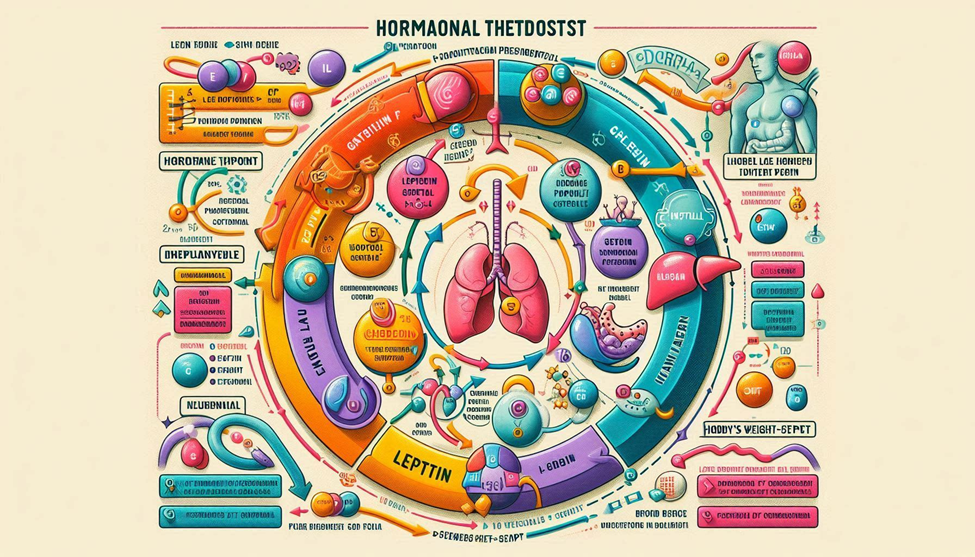
LEPTIN: THE MASTER REGULATOR OF ENERGY STORES
1.1 What Lepton Actually Is
Lepton is a hormone produced primarily by adiposities (fat cells).
Its job is simple but powerful:
- Tell the brain how much fat mass you have.
- Instruct the brain whether to speed up or slow down metabolism.
- Regulate long-term hunger and satiety rhythms.
When fat mass increases → lepton increases → appetite should decrease.
When fat mass decreases → lepton decreases → appetite increases.
This is the body’s long-term safeguard against starvation.
Lepton works primarily through the hypothalamus, influencing:
- neuropeptide Y (NPY)
- pro-opiomelanocortin (POMC)
- melanocortin pathways
- the sympathetic nervous system
- thyroid hormone output
In essence, lepton tells every metabolic system whether you are in surplus or scarcity.
1.2 Lepton Resistance: The Silent Driver of Weight Gain
Most individuals with overweight or obesity do not have low lepton.
They have high lepton, but the brain cannot sense it.
This state is called lepton resistance, and it mirrors the logic of insulin resistance:
- Plenty of the hormones exist.
- But the brain behaves as if there is too little.
- Result: It activates starvation programs.
When the brain becomes resistant to lepton, it triggers:
- relentless hunger
- slowed metabolism
- reduced thermo genesis
- increased fat storage signals
- lower thyroid output (T3)
- higher reward response to food
This is why diets often fail:
your biochemistry becomes a counter-force working actively against weight loss.
1.3 The Neurobiology of Lepton Signaling
Lepton binds to Ob-R receptors in the hypothalamus.
Activation suppresses:
- NPY (which increases hunger)
- Agro neurons (which increase feeding drive)
And activates:
- POMC neurons → α-MSH → melanocortin receptors → satiety signals
Lepton also influences:
- dopaminergic reward pathways
- vague nerve modulation
- brown adipose tissue thermo genesis
- liver glucose output
A lepton-resistant brain perceives famine even in caloric abundance.
1.4 What Causes Lepton Resistance?
- Chronic high insulin: Insulin interferes with lepton transport across the blood-brain barrier.
- Constant snacking: Elevated round-the-clock eating prevents lepton’s natural plasticity.
- Inflammation: Inflammatory cytokines disrupt hypothalamic lepton signaling.
- Poor sleep: One night of short sleep reduces lepton sensitivity by measurable degrees.
- Ultra-processed foods: They flood reward pathways, overpowering lepton regulatory circuits.
- Sedentary environment: Low physical activity decreases lepton receptor sensitivity.
- High triglyceride levels: Triglycerides block lepton transport into the brain.
1.5 Why Low Lepton after Weight Loss Makes Regain Inevitable
When you lose weight, fat cells shrink → lepton drops.
The brain interprets this drop as danger.
It responds with:
- increased hunger
- decreased satiety
- decreased resting metabolic rate
- increased efficiency of fat storage
- increased preference for high-energy foods
- stronger cravings
- reduced spontaneous movement
This is why weight regain is not a failure of willpower—it’s a predicted physiological response.
GHRELIN: THE HUNGER CLOCK THAT SETS MEAL RHYTHMS
2.1 What Gherkin Actually Does
Gherkin is produced mainly in the stomach.
Its functions include:
- initiating hunger
- stimulating appetite before meals
- increasing gastric motility
- signaling meal anticipation
- influencing reward pathways
- supporting growth hormone release
Gherkin peaks before meals and drops after eating.
Its rhythm should be predictable and circadian-synchronized.
2.2 The Gherkin-Circadian Loop
Unlike lepton (long-term), gherkin is meal-to-meal.
Its cycles are controlled by:
- stomach stretch receptors
- insulin and glucose levels
- circadian clocks in gastrointestinal tissues
- habitual mealtimes
When your meal schedule is chaotic, gherkin rhythm becomes chaotic.
Irregular gherkin leads to:
- appetite spikes
- cravings unrelated to caloric need
- night-time hunger
- loss of metabolic precision
- reduced satiety response
2.3 Gherkin and Stress Eating
Stress elevates cortical, which directly increases gherkin production.
This is one reason emotional eating feels hardwired.
Gherkin also increases dopamine release → food becomes more rewarding.
2.4 Gherkin after Weight Loss
When you lose weight:
- gherkin rises significantly
- hunger becomes stronger
- cravings intensify
- meals feel less satisfying
This is another reason maintaining weight loss is biologically difficult:
your hunger hormone works double-time to restore lost weight.
INSULIN: THE SWITCH THAT CONTROLS STORAGE, BURNING & FLEXIBILITY
3.1 What Insulin Actually Does
Insulin is produced by pancreatic beta cells.
Its primary roles:
- shuttle glucose into muscles and liver
- store excess glucose as fat
- suppress biolysis (fat burning)
- regulate metabolic flexibility
- work alongside lepton to signal energy abundance
Insulin is not “bad”—it is essential.
But chronically elevated insulin disrupts the hormonal thermostat.
3.2 Insulin Resistance and Weight Regulation
In insulin resistance:
- cells respond less to insulin
- pancreas releases more insulin
- high insulin blocks fat burning
- lepton signaling declines
- hunger increases
- cravings for crabs intensify
Insulin resistance works synergistically with lepton resistance to raise the weight set-point.
3.3 The Insulin-Gherkin-Lepton Triangle
These three major hormones operate as a triad.
When insulin is high (frequent snacking):
- gherkin suppression becomes weak → more hunger
- lepton transport to the brain decreases → more hunger
- biolysis shuts down → more fat storage
When insulin stabilizes (meal spacing):
- gherkin follows natural rhythms → predictable appetite
- lepton sensitivity improves
- metabolic flexibility increases
3.4 Insulin and Meal Timing
Insulin response is shaped by circadian biology:
- insulin sensitivity is highest in the morning
- lowest in the evening
- nighttime eating creates the strongest metabolic disruption
This is why late-night meals disproportionately raise the weight set-point.
THE WEIGHT SET-POINT: A HORMONAL “DEFAULT MODE”
4.1 What Is the Set-Point Theory?
Your body maintains a “preferred weight range” via:
- hormonal signaling
- nervous system feedback
- metabolic rate adjustments
- appetite modulation
The set-point can be:
- lowered (rare)
- raised (very common)
- defended strongly by biology
4.2 How Hormones Defend the Set-Point
When you attempt to lose weight:
- Lepton drops → hunger increases
- Gherkin raises → cravings increase
- Insulin fluctuations increase → appetite instability
Your brain activates defense mechanisms to push you back to the set-point.
4.3 How the Set-Point Increases Over Time
A raised set-point is often driven by:
- chronic overfeeding
- insulin resistance
- lepton resistance
- inflammation
- sleep disruption
- circadian misalignment
- ultra-processed foods
- sedentary behavior
Each factor gradually convinces the brain that a higher fat mass is the new safe zone.
HOW TO RESET THE HORMONAL THERMOSTAT
This is the core practical section.
Below are the scientifically supported strategies to improve lepton, gherkin, and insulin cycles.
5.1 Rebuild Lepton Sensitivity
1. Stabilize meal frequency
Constant snacking keeps lepton and insulin constantly elevated.
Aim for:
- 2–3 meals
- no grazing
- predictable meal times
2. Reduce inflammation
Key drivers of hypothalamic inflammation:
- seed-oil-rich ultra-processed foods
- high-fructose intake
- chronically high insulin
- poor sleep
- obesity itself
Anti-inflammatory dietary support:
- omega-3s (EPA, DHA)
- polyphones (berries, olive oil, green tea)
- cruciferous vegetables
- high-fiber meals
3. Sleep optimization
Every poor-sleep night:
- lepton ↓
- gherkin ↑
- cravings ↑
8 hours of circadian-aligned sleep is metabolic therapy.
4. Strength training
Muscle improves lepton sensitivity via:
- increased mitochondrial density
- reduced inflammation
- improved glucose disposal
- higher insulin sensitivity
5.2 Reset Gherkin Rhythms
- Keep consistent meal times: Your stomach learns your schedule.
- Avoid late-night eating: Night-time gherkin surges destabilize appetite for the next day.
- Eat high-protein meals: Protein reduces gherkin more than crabs or fats.
- Manage stress: Cortical → increases gherkin → triggers cravings.
5.3 Normalize Insulin and Improve Metabolic Flexibility
- Reduce constant sugar spikes: Ultra-processed snacks disrupt insulin signaling.
- Increase fiber intake: Fiber lowers insulin demand and stabilizes glucose.
- Walk after meals: A 10-minute walk reduces glucose area-under-curve significantly.
- Build muscle: Muscle is the primary sink for glucose.
5.4 Circadian Synchronization for All Three Hormones
The metabolic system is circadian-driven.
Morning:
- highest insulin sensitivity
- best time for larger meals
- best window for crabs
Night:
- lowest insulin sensitivity
- strongest lepton signaling
- highest risk of fat storage
Eating mostly in daylight strengthens:
- lepton signaling
- gherkin rhythms
- insulin sensitivity
5.5 Micro biome Modulation
Gut microbes influence:
- gherkin secretion
- insulin sensitivity
- inflammation affecting lepton
- reward pathway activity
Key micro biome-supportive foods:
- resistant starch
- insulin
- oats
- legumes
- nuts
- diverse vegetables
- fermented foods
ADVANCED ENDOCRINE MECHANISMS
6.1 The Hypothalamic “Body Weight Integrator”
The actuate nucleus receives:
- lepton signals from fat
- gherkin signals from the stomach
- insulin signals from the pancreas
This integrative center decides:
- energy expenditure
- hunger intensity
- food preference
- thermo genesis
6.2 The Reward System Loop
The dopamine system is tightly integrated with lepton and gherkin:
- When lepton is low: Food reward increases.
- When gherkin is high: Food becomes more pleasurable.
- When insulin spikes: Dopamine sensitivity shifts.
This petrochemical triad shapes cravings, overeating episodes, and food choice.
6.3 Thyroid and Lepton
Lepton regulates:
- TSH secretion
- T3 conversion
- thermo genesis
When lepton drops (dieting), the thyroid slows, reducing metabolic rate.
PUTTING EVERYTHING TOGETHER: A RESET BLUEPRINT
Below is a simplified step-by-step hormonal reset model.
- Step 1: Fix Meal Timing
- 3 meals → no snacking.
- Step 2: Morning-biased eating
- Big breakfast → small dinner.
- Step 3: Sleep cycle stabilization
- Same sleep/wake times.
- Step 4: Strength train 3–4× per week
- Supports lepton and insulin.
- Step 5: High-protein meals
- Target 30–35 g protein per meal.
- Step 6: Anti-inflammatory diet
- Whole foods → fiber → omega-3s → polyphenols.
- Step 7: Reduce nighttime eating
- Finish dinner 3 hours before bed.
- Step 8: Stress modulation
- Breathe work, walks, journaling.
- Step 9: Micro biome nourishment
- Daily fiber + fermented food.
- Step 10: Consistency for 8–12 weeks
- Hormonal cycles require time to stabilize.
CONCLUSION
Your body weight is not an accident. It is the product of a complex hormonal thermostat controlled primarily by lepton, gherkin, and insulin, which together determine hunger patterns, energy expenditure, cravings, metabolic flexibility, and long-term fat storage tendencies.
When these hormones are aligned, weight regulation feels effortless—appetite stabilizes, energy increases, and your body naturally gravitates toward a healthier set-point.
When they are misaligned, weight gain, cravings, fatigue, and metabolic slowdowns become nearly unavoidable regardless of willpower.
Modern lifestyles—irregular meals, late-night eating, constant snacking, stress, ultra-processed food, and poor sleep—push these hormones into chronic deregulation, raising the set-point and making weight loss feel impossible.
But through structured meal timing, circadian nutrition, high-quality sleep, muscle-building exercise, stress reduction, and micro biome-supportive eating, the hormonal thermostat can be recalibrated.
Your weight is not destiny.
It is biology—and biology can be reshaped with the right strategies.
SOURCES
Holloszy 1967 — Landmark study demonstrating how endurance training stimulates mitochondrial biogenesis, laying the foundation for understanding metabolic flexibility and fat oxidation adaptation.
Cahill 1970 — seminal research on human fuel use during prolonged fasting; explains ketene metabolism and glucose sparing mechanisms central to metabolic switching.
Randle 1998 — Author of the “Randle Cycle,” describing how glucose and fatty acids compete for oxidation; a foundational model for metabolic flexibility science.
Jeukendrup 2003 — Research exploring substrate selection during exercise, highlighting how trained athletes shift between carbohydrate and fat metabolism efficiently.
Good aster 2003 — Investigates intramuscular lipid metabolism and the role of muscle insulin sensitivity in determining metabolic flexibility.
Storyline 2004 — examines how high-fat and high-crab diets influence insulin resistance, mitochondrial performance, and metabolic switching capacity.
Sprite 2004 — focuses on fuel utilization during exercise and the regulatory mechanisms controlling carbohydrate vs. fat oxidation.
Bruce 2006 — Study detailing the physiological effects of exercise intensity on substrate choice and mitochondrial enzyme activation.
Hawley 2006 — demonstrates how nutrition and training interact to remodel skeletal muscle metabolic machinery, influencing fuel switching.
Benton 2007 — Research linking blood glucose stability with cognitive performance, offering insight into metabolic inflexibility symptoms such as fatigue and cravings.
Martin 2011 — Reviews human performance adaptations during fasting and caloric restriction; reinforces the evolutionary role of metabolic flexibility.
Van Loon 2013 — focuses on muscle glycogen metabolism and how carbohydrate availability affects both fat oxidation and athletic output.
Kirkpatrick 2014 — Discusses dietary strategies (including low-crab and high-crab cycling) that influence AMPK, motor, and insulin signaling.
Kelley 2015 — Research showing how mitochondrial dysfunction contributes to metabolic inflexibility in obesity and insulin resistance.
Galvani 2015 — Explores individual variability in metabolic flexibility and its relation to metabolic disorders and energy balance.
Hansen 2016 — Provides evidence on how intermittent fasting and nutrient timing affect metabolic signaling and mitochondrial efficiency.
Broun’s 2016 — Reviews carbohydrate quality and glycolic response, emphasizing their impact on insulin sensitivity and metabolic switching.
Mann 2017 — Analyzes dietary patterns and their impact on substrate oxidation, particularly in relation to circadian rhythms.
San-Milan 2018 — a key work showing that elite endurance athletes possess exceptionally high mitochondrial flexibility, explaining their fuel-adaptive capacity.
Coyle 2018 — investigates the influence of exercise intensity and training status on metabolic regulation and carbohydrate–fat interplay.
Peters 2019 — explains how chronic inflammation and oxidative stress impair metabolic fuel selection through mitochondrial dysfunction.
Egan 2020 — Reviews molecular regulation of metabolic enzymes, highlighting the role of nutrient-sensing pathways (AMPK, PGC-1α) in metabolic remodeling.
Roberts 2020 — demonstrates how resistance training enhances GLUT4 density, improving glucose uptake and metabolic flexibility.
Hating 2021 — explores the liver’s role in metabolic signaling, glucagon regulation, cytogenesis, and whole-body fuel switching.
HISTORY
Current Version
Nov 19, 2025
Written By
ASIFA
0 Comments